NIU’s new Board of Trustees wasted no time making its presence felt in Springfield as well as DeKalb.

One of the board’s first major actions was a move recommended by President John La Tourette and Senior Vice President for Finance Eddie Williams: get permission to do public-private land deals, and expand the campus in the only possible direction – to the west.

The first move allowed NIU to designate what we now call the North Forty (where Engineering and Business now stand) and some 289 acres to the west of campus as special zones in which the university could enter into partnerships with private business. That was approved by the legislature in March of 1997.

Then, in June of 1997, the Board approved the purchase of around 200 acres contiguous to the West Campus – formerly agricultural land – for $2.95 million.

“I cannot overstate the importance of the location, nor how attractive the price was to our board,” Williams said. “They strongly believed that it was prudent to acquire the property now, rather than wait five or six years when rates would be substantially higher.”

“Northern has been landlocked for many years, and remains so to the north, south and east,” said La Tourette. “This purchase is very important to the future of the university because it allowed us to expand our campus borders on land that is directly contiguous to our campus.”

A few months later, the board added another 32 acres that had been an odd-shaped cut-out to the first parcel at a price of $414,000.

Seven years later, when U.S. House Speaker (and NIU alumnus) Denny Hastert was in power, NIU received $8.32 million out of a nearly $300 billion federal transportation bill to plan, design and build new roads and infrastructure on the Far West Campus so that development could begin on the 230 acres.

The first building constructed on what became known as the Far West Campus was the Center for the Study of Family Violence and Sexual Assault, located just north and west of the Convocation Center and completed in 2003.   Next was the Northern View Community, an apartment complex to replace Married Student Housing and provide facilities for students with children.

Currently in the works is the Northern Illinois Center for Community Sustainability, with a 30,000 square-foot building as well as experimental gardens and other possible facilities such as a solar energy “garden.”

Click on photos to enlarge

A land-locked NIU had only one direction to move when, in 1997, a parcel of contiguous land became available to the west of campus. In the end, the university added about 240 acres with the purchase of former farmland west of the Convocation Center.
Senior Vice President for Finance Eddie Williams led efforts to gain approval for public-private land deals. He also negotiated very favorable terms for the purchase of two land parcels totaling 240 acres and creating what is now called the Far West Campus.
Date posted: December 2, 2020 | Author: | Comments Off on Board enlarges campus with purchase of far-west land (1997)

Categories:

The story of NIU Jazz begins in 1969 with the arrival on campus of a music teacher named Ron Modell. Tasked with creating a jazz program from scratch, Modell auditioned 60 hopeful musicians for 20 available chairs in the new ensemble.  Just six weeks later, the NIU Jazz Ensemble played its first concert.

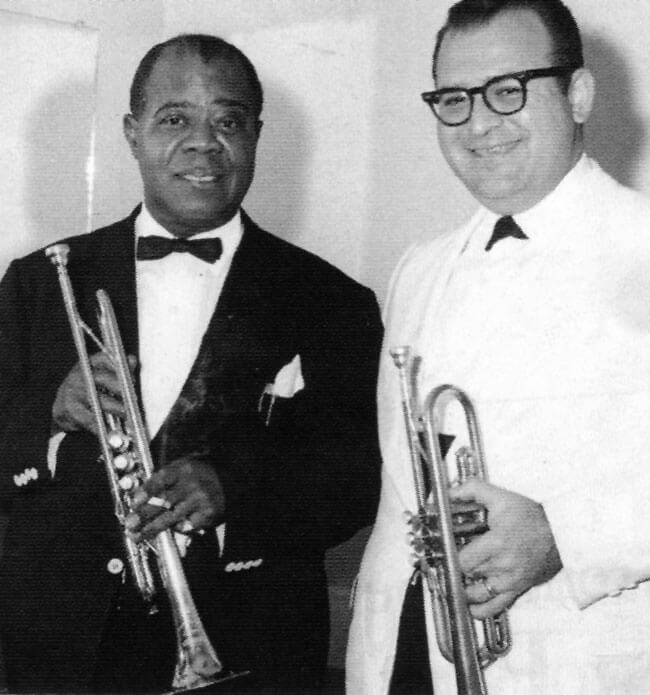
Modell was an accomplished trumpeter who had played with all the greats – Louis Armstrong, Maynard Ferguson, Duke Ellington, Dizzy Gillespie, Louis Bellson and many more. His talent, outgoing personality and strong connections in the music world introduced his students to dozens of jazz stars and travel opportunities beyond their wildest imaginations.

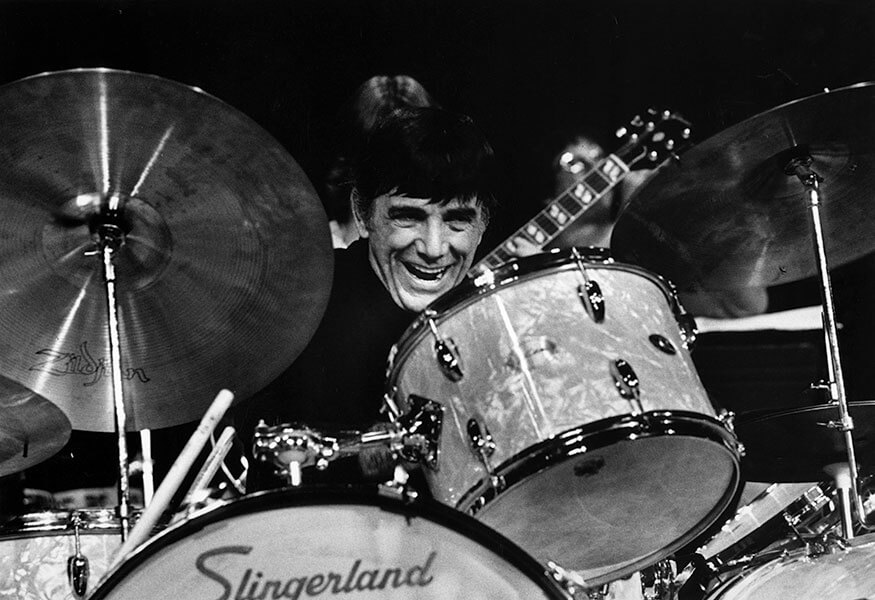
By 1983, Downbeat magazine had named the NIU Jazz Ensemble the top college jazz band in the country. The following year, WTTW public television in Chicago produced a documentary titled A Year in the Life of the Greatest College Jazz Band in America. Among the many great performances captured in that film was a friendly drum battle (excerpted below) between NIU student Vern Spevak and the acknowledged king of percussion, Louis Bellson.

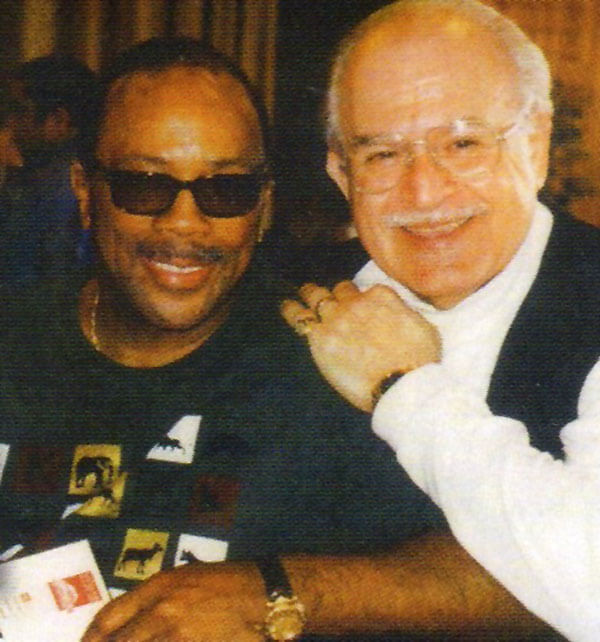
In the summer of 1996, jazz great Quincy Jones asked the NIU Jazz Ensemble to be the band for a tribute to his 50-year career at the world-renowned Montreaux (Switzerland) Jazz Festival.

Modell quickly agreed, seeing the concert as an opportunity for his students to “audition” for many jazz greats, who would in turn spread the word about NIU’s outstanding jazz program.

After their triumph at the four-hour Quincy tribute, the exhausted but exhilarated students were asked to play on an outdoor stage the next day for people who had not been able to buy tickets. They played for two hours – and were called back for three encores.

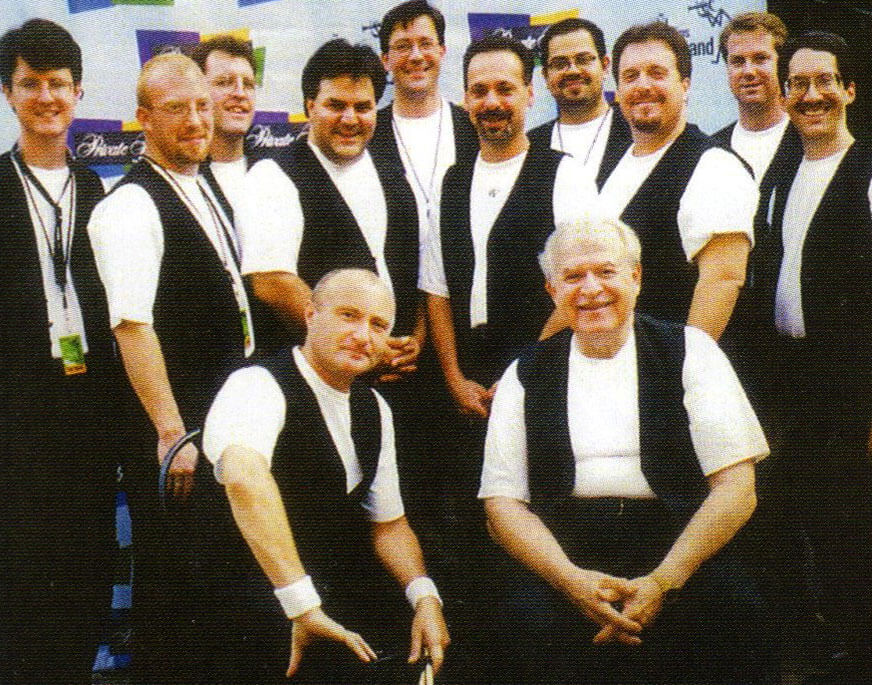
Pop star Phil Collins played at Montreux that year, and took special note of the NIU Jazz Ensemble.  Two years later, he invited them to play for his world-wide summer Big Band tour. Modell came out of retirement to recruit a group of Jazz Ensemble alumni who played with Collins all over the world, including at the Taste of Chicago in Grant Park.

“This band is absolutely fabulous,” Collins told Chicago Tribune music critic Howard Reich.  They’re so hungry and so ready. I’m the one who’s actually slowing them down!”

The hard-to-impress Reich agreed.  “Collins has an extra weapon in his arsenal: the musicians from Northern Illinois University.”

Click on photos to enlarge

Ron Modell, an accomplished trumpeter who played with such jazz greats as Louis Armstrong, eventually turned to teaching and the goal of creating a world-class jazz program.
Among NIU’s biggest fans was Louis Bellson, considered the greatest drummer of his time. Below is a link to Bellson and NIU student Vern Spevak engaged in a spirited competition featured in a 1984 WTTW documentary about the NIU Jazz Ensemble.
Quincy Jones invited the Ensemble to the Montreux Jazz Festival to serve as his band for a 50-year tribute to Jones’ career.
After hearing the NIU Jazz Ensemble at Montreux, pop star Phil Collins engaged an alumni version of the group to serve as his back-up band during Collins’ world-wide summer Big Band tour.
Date posted: December 2, 2020 | Author: | Comments Off on NIU Jazz Ensemble caps off decades of achievement at Montreux festival (1997)

Categories:

After 14 years at the helm, NIU President John La Tourette took the occasion of the June, 1999 Board of Trustees meeting to announce his retirement.

The Board of Trustees, in existence for just three years at this point, had a huge challenge in replacing La Tourette, a well-accomplished president who had set many wheels in motion for the next president to manage.   

They needed a president with broad operational and strategic planning experience, talent in the fundraising and legislative arenas, and knowledge of Division I athletics. 

With the help of an executive search firm and a 20-member search committee, the board was looking at finalists by February 2000, and announced their choice the following month. 

On March 24, John G. Peters, provost and chief academic officer at the University of Tennessee, was named the 11th president of Northern Illinois University.

A political scientist by training, Peters’ teaching career began at the University of Nebraska – Lincoln, where he and wife, Barbara, would spend the next 20 years of their life and welcome their son, Russell. Over time, Peters moved into various administrative positions at UNL, including Dean of the College of Arts and Sciences. From UNL he was recruited to be the vice chancellor for academic affairs at the University of Tennessee, and finally provost.

The NIU presidency seemed to be tailor-made for John Peters, and he for it.  In his first few months at the helm, Peters sealed the deal on a $20-million gift to the College of Business; gained NIU admittance to the prestigious Association of Public and Land-grant Universities (APLU); and oversaw NIU’s ascension to the Carnegie Foundation’s list of most prestigious research universities.

He followed up those accomplishments with a series of trips to Washington, where he engineered several special appropriations to strengthen top NIU programs. Those included a $4.2 million grant for an NIU-led accelerator research project with Fermilab and the first of two grants used to construct the Center for the Study of Family Violence and Sexual Assault.

In Springfield, Peters’ personal lobbying efforts helped move several stalled university proposals out of political waiting rooms.  Those included money for the Altgeld Hall renovation, funds for a massive flood control project and an even larger heating and air-conditioning project, and $4.5 million for an expansion at Founders Library.

At the same time, John Peters managed to endear himself to NIU students. He frequently walked around campus, looking for students to talk to, to test ideas and get feedback. He diligently taught University 101 classes, and once surprised a class by inviting them all over for dinner. And he constantly reminded students of NIU’s great value and growing prestige.

“I want you to know that you’ve chosen a top-notch university,” he told them, “and when you hang an NIU degree on your wall, you’re going to go far.”

The Peters era included more than a dozen major building projects, including new and renovated academic and research spaces, athletic facilities, entertainment venues and residential facilities. Lobbying in Washington and Springfield provided funds for some projects, while unprecedented private giving underwrote others.

Yet in spite of those and other accomplishments, the Peters legacy is most strongly associated with NIU’s darkest hour, for it was on his watch that NIU experienced a mass shooting on February 14, 2008.

From the first minutes of the crisis to the last, John Peters focused on the victims. He visited hospitals, attended funerals, comforted families and held the hands of traumatized students. He shared information promptly and compassionately, and urged his fellow NIU leaders to err on the side of kindness when making decisions on how to move forward. In the end, NIU emerged from the February 14th tragedy as a united campus, its president held up as a model for grace under pressure. 

Peters stayed on for another five years, focused on financial management in a period of accelerated state disinvestment, as well as private fundraising and athletics. He led the MAC Council of Presidents and represented the Mid-American Conference on the NCAA Executive Committee.  He also helped seal the deals on private gifts that created new athletic practice and performance facilities on campus.

At the same time, Peters rounded out his 13-year presidency by presiding over a residential renaissance, using public-private partnerships and low-interest bonds to build the New Hall residence hall and Northern View apartments, while also remodeling Grant Towers and Gilbert Hall.

At his final State of the University Address in October of 2012, John Peters announced his retirement, effective June 30 of 2013.  John and Barbara returned to their home in Knoxville, Tennessee, rejoining their son and his family. As of this writing, they continue to enjoy the mild climate of their adopted hometown and proximity to their much-adored grandchildren.

Click on photos to enlarge

Peters was a political scientist by training, and spent 20 years in the classroom at University of Nebraska before moving into administrative positions there and at Tennessee.
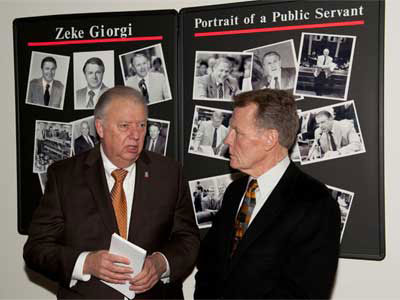
Peters’ personal lobbying efforts in Springfield moved several stalled proposals out of political waiting rooms. Here he is pictured with former long-time House Speaker Mike Madigan at the opening of the NIU Zeke Giorgi Legal Clinic in Rockford.
Peters brought a wealth of knowledge with him from two big-time athletic programs (Nebraska and Tennessee). During his tenure he headed the MAC Council of Presidents and was the conference’s representative to the NCAA committee that created the former BCS football bowl system.
Barbara Cole Peters shared her passion for vintage fashion with the NIU community, and wrote a series of books about the early women of Northern Illinois State Teachers College.
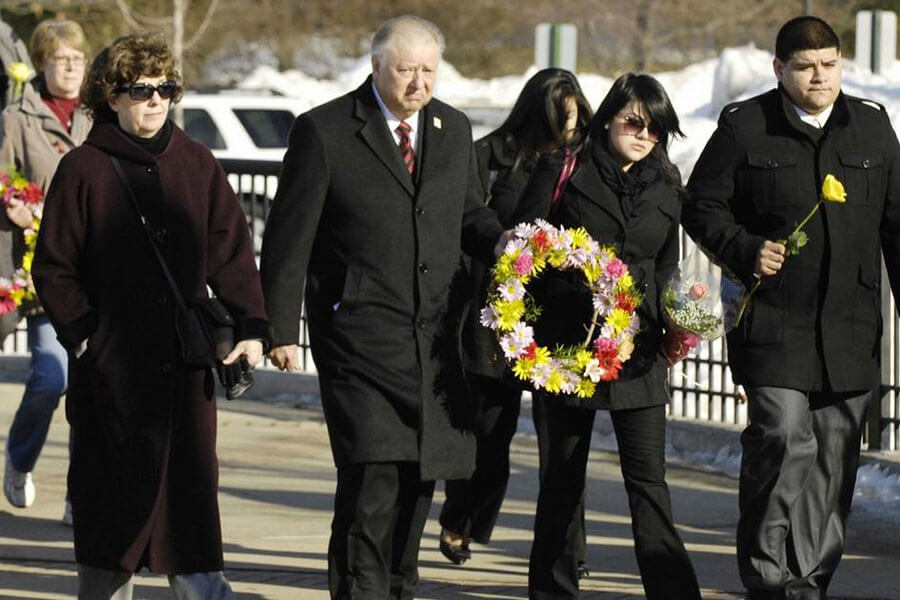
John and Barbara Peters led the annual wreath-laying ceremony to honor five students killed in a mass shooting on Feb. 14, 2008.
Among the accomplishments of the Peters presidency was a “residential renaissance” in which existing residence halls were renovated and two new living quarters — Northern View apartments and New Hall — were built.
Date posted: January 21, 2021 | Author: | Comments Off on John G. Peters named 11th president (2000)

Categories:

In the fall of 2000, President John Peters announced that Northern Illinois University had been accepted as the newest member of the nation’s most prestigious public higher education association – what was then known as the National Association of State Universities and Land-grant Colleges, or NASULGC.

“Given our role, our mission, the size of our organization and the impact we have on the region, it seemed to me that NIU fit perfectly in the NASULGC profile,” Peters explained. “I’m pleased to announce that the NASULGC leadership also saw NIU as an excellent fit in an organization of the nation’s top universities.”

NASULGC President Peter Magrath said the association’s membership is made up of those top universities with specific missions involving economic development and societal improvement.

“America’s state universities and land-grant colleges – all of them truly peoples’ universities – are a marvelous enterprise that has served our nation superbly,” Magrath said.  “NIU and its fellow NASULGC universities are a critical part of public higher education, essential to the well-being of our nation’s economy and society.”

At the time NIU was admitted, only 210 of more than 4,000 American colleges and universities were members of NASULGC. In Illinois, only NIU, the University of Illinois and SIU were members. NASULGC member institutions at the time enrolled more than 3.2 million students, about a quarter of whom were members of racial and ethnic minority groups.

NASULGC/APLU was founded in 1887 and remains the nation’s oldest non-profit higher education association.

In 2009, NASULGC changes its name to the simpler Association of Public and Land-grant Universities, or APLU.

Click on photos to enlarge

Peter Magrath was NASULGC president when NIU was considered for membership. Magrath called NIU and its fellow association members “essential to the well-being of our nation’s economy and society.”
In 2009, NASULGC changed its name to the Association of Public and Land-grant Universities, or APLU.

Date posted: January 16, 2021 | Author: | Comments Off on NIU admitted to top national association for public universities (2000)

Categories:

A second major public recognition of NIU’s growing reputation was its designation by the Carnegie Foundation for the Advancement of Teaching as one of the nation’s top research institutions.

A new Carnegie classification system categorized the extent of research activities at each university, and that category became shorthand for a level of prestige that influenced funding agencies.

NIU was placed in the category of “doctoral/research university – extensive” – a group that included less than four percent of American institutions.

To be placed in the doctoral/research university-extensive category, a university had to offer a wide range of baccalaureate programs and award at least 50 doctorates per year in at least 15 disciplines. In 2000, NIU was offering doctoral degrees in 17 disciplines, and awarded 116 doctorates that year.

Click on photos to enlarge

The Carnegie Classification system has been the leading framework for recognizing and describing institutional diversity among American universities. Starting in 1970, the system is widely used in the study of higher education.

Date posted: January 21, 2021 | Author: | Comments Off on NIU earns Carnegie Foundation designation as top-tier research university (2000)

Categories:

In December of his first year as NIU’s president, John Peters announced “an aggressive regional outreach strategy” as the next logical step for a university on the rise in a dynamic region.

Along with enhancing the campus undergraduate experience and building graduate and research programs, Peters said NIU needed to “lay claim to the Chicago region as the firm domain of this very strong public university.”

“Extension, outreach, continuing education and public service are core functions of the institutions that make up NASULGC, the National Association of State Universities and Land-Grant Colleges,” the president explained. “While NIU has a long tradition in this areas, our new status in the higher education community nationwide really requires us to expand our mission to serve off-campus audiences.”

To that end, Peters challenged the deans and other campus leaders to develop strategic off-campus academic plans, and began to consolidate various departments and programs with distinctly off-campus missions.

By the spring of 2001, Peters announced the creation of the new Division of Outreach, comprised of the four regional campus sites (Hoffman Estates, Naperville, Rockford and Oregon); NIU eLearning Services; the former Continuing Education unit; the Center for Governmental Studies; Northern Public Radio; and a handful of niche programs such as the Illinois Council on Economic Education and the popular Motorcycle Safety program. Information Technologies remained part of the administration side of the division, and would come to play an important role in NIU’s regional outreach strategy.

Veteran administrator Anne Kaplan, vice president for outreach and administration, was called upon to make the new division work. In fairly short order, Kaplan and her team had created new revenue streams that allowed the Outreach operation to be more entrepreneurial. She encouraged her staff to think big, and they did not disappoint: Among Outreach’s early accomplishments was creation of a regional fiber optic network supported by a $68 million federal grant.  

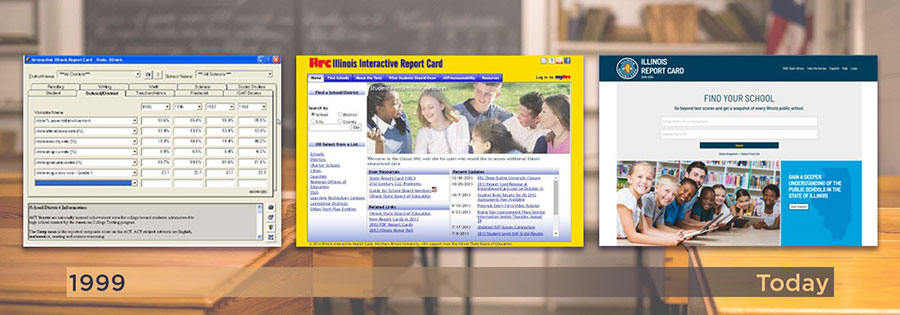
 And when President Peters launched the P-20 initiative to coordinate university leadership of educational improvements from pre-school through graduate school, he tapped Outreach to lead the way. In addition to providing focus for a university-wide effort, P-20 begat several additional programs that continue to this day, including the STEM Education initiative and the Illinois Interactive Report Card (IIRC).

At the time Outreach was created, nearly one-sixth of all NIU students took classes at the regional centers, primarily at night and on weekends. In addition, the centers hosted hundreds of events each year, firmly planting the NIU flag throughout the region with a physical presence.

Before the decade was out, NIU had a new strategic plan, and it called outreach “a defining institutional value.” The Carnegie Foundation for the Advancement of Teaching recognized NIU’s solid outreach commitment with a 2008 designation as an Engaged University.  In 2013 the division received a new name that better recognized its role in the region: the Division of Outreach, Engagement and Regional Development. Later that same year, NIU received APLU’s inaugural Innovation and Economic Prosperity Award, recognizing universities that do the best job of engaging with the regions they serve.

Click on photos to enlarge

Veteran administrator Anne Kaplan was tapped to head the new Division of Outreach and Administration.
The outreach education centers in Naperville, Hoffman Estates, Rockford and Oregon were among the diverse units managed by the new division.
Beginning as a way to connect the main campus with regional education centers, NIUNet and its successor programs connected campuses and communities throughout Illinois with high-speed fiber-optic broadband.
The Illinois Interactive Report Card compiles and presents detailed information on individual schools and districts, including student performance data. It is widely used in education improvement planning and by families and agencies throughout Illinois
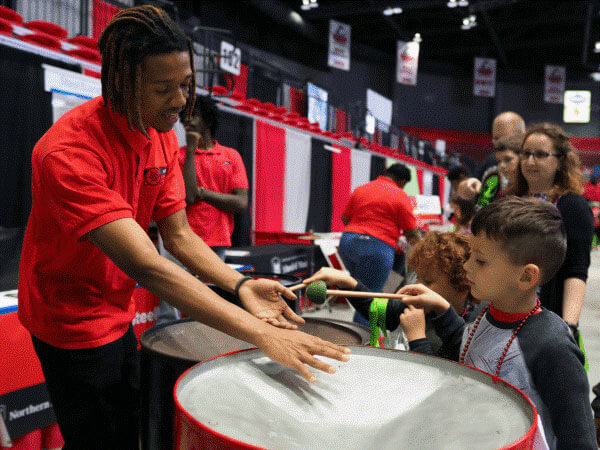
STEMfest is the annual crowning achievement of program that makes science, technology, engineering and math come alive for K-12 students throughout the region. Since its inception, STEMfest attracts 5,000 – 7,000 people each year to the Convocation Center event.
The Center for Governmental Studies works with municipalities and public organizations to guide decision-making and strategic planning.
Northern Public Radio informs and entertains more than 100,000 listeners in northern Illinois and southern Wisconsin each week through its five-station network.
Date posted: January 21, 2021 | Author: | Comments Off on New division established to coordinate university outreach (2001)

Categories:

In the spring of 1999, a proud NIU alumnus visited the College of Business and was delighted to see that the high quality faculty and programs he remembered continued to be a major source of university pride.

But Dennis Barsema, then 47 and a successful tech company executive, was less impressed with the facilities. On a tour of Wirtz Hall, he spied a bucket catching drips in a hallway. Barsema later said that he had always dreamed of doing something big for his alma mater, and in that moment he knew how he could make a difference.

In the fall of 2000, Barsema and his wife, Stacey, announced a gift of $20 million to the university to build a new home for the College of Business.  In addition, they gave $500,000 to establish the Dennis and Stacey Barsema Endowed Scholarship in Business and $225,000 to fund the Business Information Technology Transfer Center (BITTC).

The Barsemas’ generosity was born of gratitude.

Dennis Barsema, a community college transfer student who admitted he struggled to get B’s in his management classes, found the inspiration and support he needed at NIU to succeed in the world of business and tame a lifelong battle with stuttering. The Naperville-area native first sold calculators door-to-door and worked his way up through the telecom industry ranks to lead one of the largest initial public offerings of stock in Wall Street history.

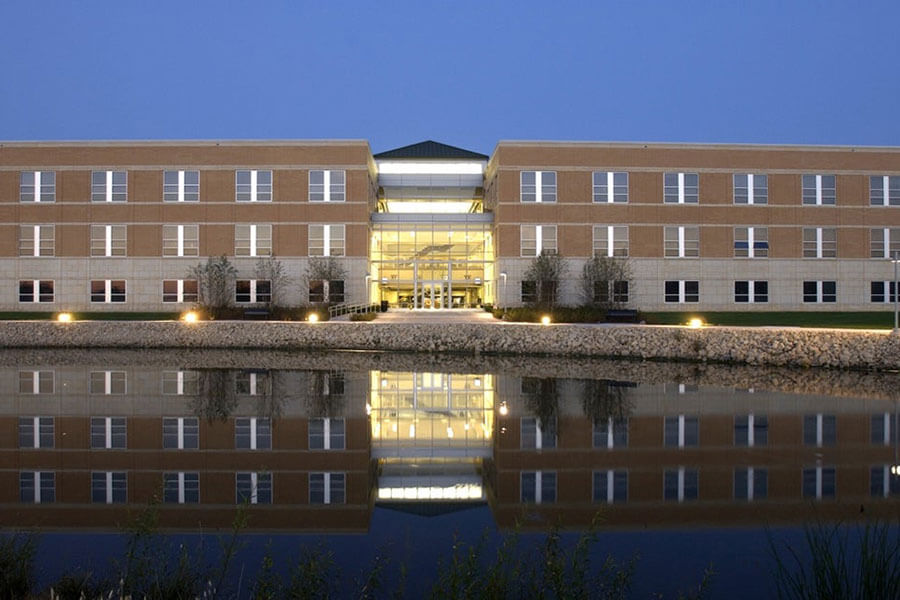
When Barsema Hall opened in 2002, it was unlike any other building on campus. Technology-infused and utterly modern in its design, the facility continues to set the standard for business schools nationwide.

The three-story, 130,000-square-foot structure was anchored by a soaring three-story atrium with a central café, coffee bar, tables and booths where students could meet, study and relax. Communal space was also found throughout the building in spaces both large and small, encouraging the team projects that became a hallmark of NIU’s College of Business experience.

With 22 classrooms, four computer labs with 140 workstations and a 350-seat auditorium, Barsema Hall was wired with 650 Internet connections (in contrast to COB’s former home, Wirtz Hall, which at the time had zero connections for laptop users).

“This building is a concrete example of my commitment to the goal of helping the Chicago area become the next great technology center in the United States,” Dennis Barsema told a crowd at the building’s grand opening.

“If you look at Silicon Valley, or Boston, or Austin, education was the foundation on which the technology boom was built in those towns. For that to happen here, we must refocus education on training people who will create or run high-tech companies,” he said.

While students and faculty reveled in the comfort and cutting-edge technology of their new home, then-Dean David Graf said the Barsemas’ real gift to NIU was that of pride.

“This building gives us a certain cachet that has always been missing,” Graf said.  “When people see Barsema Hall, they know that the college is something special, otherwise we never would have been deserving of such a gift.”

“Higher education is something we both feel very strongly about, and I don’t have to be an NIU alumnus to know what a huge impact Northern had on Dennis,” Stacey said.

“He has a great passion for NIU, so when we began considering how to share our success, it was a natural that we turn here.

For their part, the gift that made Barsema Hall a reality was just the first step in a two-decade-long reconnection with NIU. Both Dennis and Stacey joined the NIU Foundation Board, and Dennis taught part-time in the building that bears his name. As of this writing, Dennis is also chair of the NIU Board of Trustees.

Click on photos to enlarge

College of Business Dean David Graf with donors Dennis and Stacey Barsema, whose $20 million gift built Barsema Hall. A technology company executive and proud NIU alumnus, Dennis credited the university for his success. The Barsemas’ gift set an example for other NIU-supporting philanthropists, as several other projects received seven-figure gifts over the next decade.
A three-story atrium and windows throughout Barsema Hall create a bright, sun-infused learning environment. Each faculty office has a window as well.
The 350-seat auditorium hosts countless classes and a steady stream of guest speakers from business and industry.
Date posted: January 21, 2021 | Author: | Comments Off on Barsema Hall opening signals new era for NIU, College of Business (2002)

Categories:

It was 1971. The Guess Who headlined NIU’s Winter Carnival. The men’s run-and-gun basketball team averaged nearly 93 points a game. And the staff of the Norther, the university’s yearbook, rallied in support of building a new home for concerts and sporting events alike. It would be on the western edge of campus with 10,000 chairback seats and parking for thousands outside.*

The early push for an arena in the 1970s ultimately failed, but it was an idea that would not die. The need for a large venue to showcase athletics, provide large-scale entertainment, and host conferences, job fairs and other big events grew only more clear as the decades marched on. 

In the late 1980s, a contingent on the Board of Regents pushed President John LaTourette to “get moving” on an arena. UIUC, SIU and ISU all had such facilities, and they were boons to the communities in which they were located.  When LaTourette pushed back, asking for time to properly study financing options, he nearly lost his job. At the same time, LaTourette genuinely believed in the arena concept, and spent a good part of the early 1990s building support – and a business plan – for the facility.

In 1998, La Tourette took a plan to the new Board of Trustees. He said the proposed “convocation center” would solve several university problems at once: 

First, the multipurpose center would include an indoor track, allowing NIU to field a women’s track team, thereby meeting Title IX requirements to offer a balanced set of athletic opportunities to men and women.

Second, the development of many acres would create thousands of new parking spaces for NIU’s burgeoning student population. Then as now, campus parking was a problem.

Third, NIU’s student recreation center was bursting at the seams. LaTourette’s plan was to move all Evans Field House operations to the new arena, allowing Evans to be remodeled as a rec center annex.

LaTourette spent the following year shopping his plan around, holding meetings with students and community leaders, and generally gaining the support for the facility, which was to be funded with student fees, user fees and generated revenues. In April of 1999, the Board of Trustees approved the plan and set a budget at $36 million. Student Trustee Joe Sosnowski told his fellow board members that students were “very enthusiastic” about the project, and said most were saying that “it’s about time.” The Student Association Senate passed a resolution in favor of the arena, sponsored by 20 SA senators.

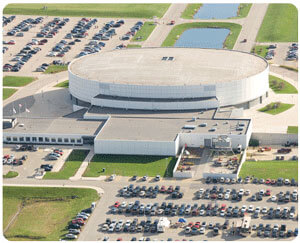
Ground was broken on 52 acres just west of NIU’s residence halls in October of 1999, with a timetable of about 20 months to completion. Drawings from the period show an expansive, multi-level, bowl-shaped arena with an eight-sided video board and video screens suspended from the center of the ceiling.

With a total of 215,000 square feet, the project included an NCAA-level indoor track,  practice gym and volleyball court, and an attached building with offices, an auxiliary gym with bleacher seating for 800, a media center, food preparation areas and a large lobby/reception space.

Designed to be flexible, the retractable seat feature allowed the bowl to be set up for many different audience sizes and performer needs. In its largest set-up, the arena could seat 10,000.

In August 2002, the Convocation Center opened its doors for the first time, hosting  the Huskie Bash new student welcome party that caps Move-In Day.  All that week, different audiences were introduced to the center in VIP receptions and events that included a concert with student-favorite band Mike and Joe and a sold-out performance by comedian Bill Cosby.

The following month NIU’s Convocation Center hosted the rock bands Counting Crows and Dishwalla; in November the men’s and women’s basketball teams began play at the new venue.

While John LaTourette began the Convocation Center project, it was his successor, John Peters, who opened the facility. 

“I’ve seen arenas like this one inject tremendous pride into a campus and its host community,” Peters said. I’ve seen students plan their free time around the many options presented by a large-scale entertainment venue like this one. I’ve seen area businesses enhanced by a steady flow of new customers. I’ve seen all those things, and I have every reason to believe that we’ll see the same benefits at NIU.”

Click an image to enlarge

The Convocation Center sits on 52 acres just west of NIU’s residence halls and is surrounded by parking lots that can accommodate more than 5,000 vehicles.
Men’s and women’s basketball, volleyball, wrestling and gymnastics practice and compete at the Convocation Center.
A Convo Center auxilliary gym with retractable seating for 800 is the home of NIU volleyball.
The arena can be set up in a variety of formations for concerts, plays, lectures and other events.
NIU’s largest facility is a popular venue for conventions, trade shows and job fairs.

*From Fall 2002 Northern Now article by Mark McGowan

Date posted: January 21, 2021 | Author: | Comments Off on NIU Convocation Center opens (2002)

Categories:

Put yourself in the shoes of a typical Northern Illinois University football fan.  In reality, success for the Huskie Nation had been a rare commodity with only ten winning seasons since moving to the major-college ranks in 1969.  Okay, there was the 10-victory California Bowl team in 1983, the nine-win Stacey Robinson breakout season in 1989, but not much else to write home about in the interim.

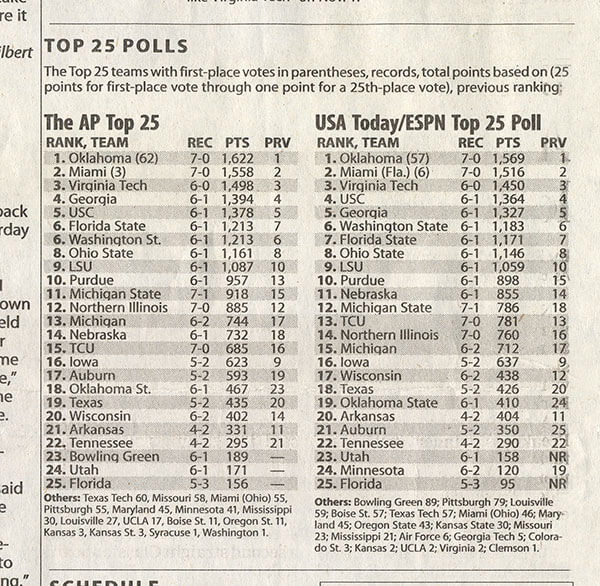
Until 2003’s visit to the Fantasy Island college pigskin paradise, that is.  Seven consecutive triumphs to open the season for the first time since 1963, ten Ws for only the third time at Northern Illinois and, overall, 16 successive weeks in both the Associated Press and ESPN / USA Today coaches polls—including the highest ranking in NIU history (No. 10 in the Bowl Championship Series ratings and No. 12 in the AP on October 12).

By beating No. 15-ranked (AP) Maryland, 20-13, in overtime, winning at No. 21-rated (AP) Alabama, 19-16, and besting Big 12 Conference representative Iowa State, 24-16, head coach Joe Novak’s Huskies became the first Mid-American Conference program to defeat two Top 25 BCS opponents and three BCS foes in a single season.

Coming off an 8-4 campaign in 2002 when NIU defeated Wake Forest, 42-41, in overtime and upset coach Urban Meyer’s No. 20 (AP) Bowling Green State club, 26-17, the locals were the pre-season favorites for the MAC crown and West Division title.  “I thought we’d be a pretty good team,” Novak said in 2020.  “(Actually) we were better than I ever thought we’d be.” Asked about the aggressive 2003 non-conference schedule, Novak replied:  “I remember when (NIU AD) Cary (Groth) asked me about adding Alabama.  We already had Maryland and Iowa State.  I was afraid we bit off more than we could chew.”

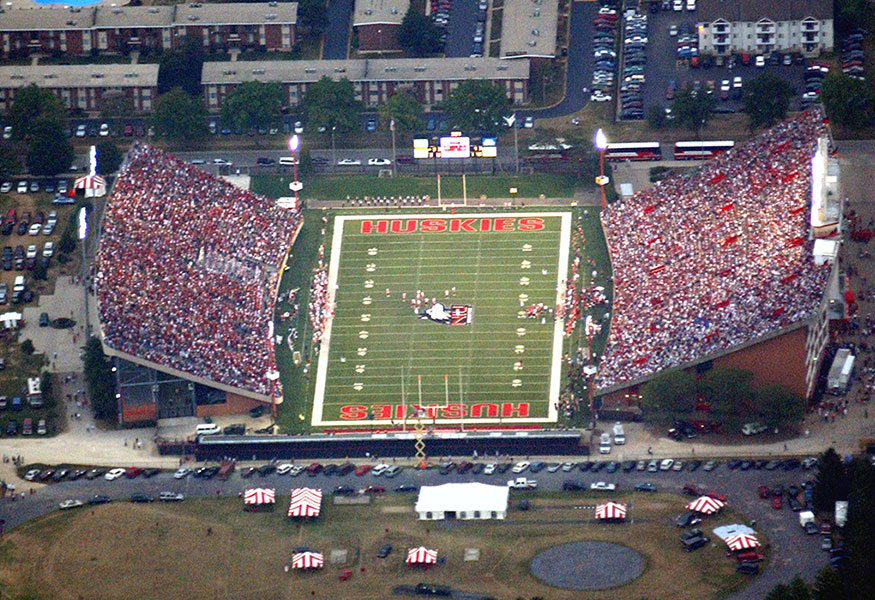
But these Huskies could really bite.  No longer an also-ran, Northern Illinois became Boise State East.  As a result of the giddy achievement, record Huskie Stadium crowds (and people actually scalping tickets for the Maryland opener on Annie Glidden Road), and unprecedented national media exposure, there was talk of crashing the BCS playoffs.

On every level, the fun started August 28 vs. Maryland.  That a.m., All-America tailback candidate Michael “The Burner” Turner was the highlighted cover story on the front page of the USA Today sports section.  By 11 p.m., the NIU-Terrapin OT thriller was the No. 1 story on ESPN’s SportsCenter, thanks to a Fox Sports Net national cablecast that reached 95.4 million homes in the U.S.A. and overseas on the Armed Forces Network.  With over 150 credentials issued for the game, the Huskie Stadium press box hosted the largest ever media contingent ever for a MAC home contest that included writers from USA Today, Washington Post, Chicago Tribune, Chicago Sun-Times, and Cleveland Plain-Dealer.

The next week, Northern Illinois outlasted NCAA 1-AA foe Tennessee Tech, 42-7, at home, but had to survive the sudden national onslaught from the Fourth Estate.  “It’s been crazy,” Novak admitted.  “New York, Los Angeles, Seattle.  Radio talk shows all over (WFAN-AM in NYC, ESPN radio, Sporting News radio, etc.).  It’s just hard to realize the magnitude of that (Maryland) game.”  America, there was more NIU to come.

Twenty days after Maryland on September 20, Northern Illinois outlasted the Crimson Tide in Bryant-Denny Stadium before 83,018 spectators.  For the second straight Huskie Top 25 victory, a QB Josh Haldi touchdown pass to WR Dan Sheldon marked the difference.  The Alabama victory and the 3-0 record positioned NIU into the Top 25 polls (No. 20 in the AP and No. 22 in the ESPN / USA Today) for the first time.  That Sunday’s newspaper headlines covered every angle:  “Gone to the Dogs” (Huntsville Times), “Upset is old hat for Huskies” (Chicago Tribune), “Huskie heaven” (Daily Herald), “Party Crashers” (Houston Chronicle), and, maybe the best, “Bama burned” (Birmingham Times).

Post-game in the NIU locker room, president John Peters congratulated Novak, his staff, and the team after the ritual Huskie Fight Song and celebration. “You know, Joe,” Peters said, “I was the provost at Tennessee for 10 years.  Five times we came to Alabama and lost each time.  Now we come down with Northern and we win.  I don’t know if the young men realize what they have accomplished here tonight.”  Observed the Rockford Register-Star:  “David left for Tuscaloosa.  Goliath returned.” Turner led all rushers with 156 yards on 27 carries.  That night on SportsCenter, ESPN anchor Chris Berman talked about Turner with a bottle of the infamous “Turner the Burner” hot sauce on his desk.  The same hot sauce bottle the Des Moines Register (“Message in a Bottle”) would later immortalize on the front of its sports section.

By the next Wednesday, NIU Intercollegiate Athletics sold 1,367 unclaimed tickets for the Iowa State game in 75 minutes which resulted in the second Brigham Field sellout of the season.  The No. 20-rated Huskies rallied from behind for the third time in 2003.  “In my wildest dreams I never imagined we’d get off to a 4-0 start,” Novak admitted.  In the role reversal quote of the game, ISU coach Dan McCarney rationalized the Cyclones’ loss to a mid-major, albeit a Top 25 one.  “We showed character against a ranked team on the road,” McCarney said.

Three games later, the No. 12 Huskies were one of only five unbeaten NCAA I-A programs and headed to northeast Ohio, for the ultimate MAC showdown vs. No. 23 Bowling Green State and a national TV date on ESPN2 with the pre-game “GameDay” crew of ex-NIU coach Lee Corso, Chris Fowler, and Kirk Herbstreit camped near Doyt Perry Stadium.  BGSU got revenge for 2002 with a 34-18 win.  The clock had struck midnight for Cinderella Northern Illinois.  And then again in a loss at Toledo.

At this juncture, injury attrition hit the Huskie line-up that was now missing at least four All-MAC performers.  Of the nation’s top 23 programs, record-wise in 2003, 10-2 NIU wound up bowl-less despite tying for the ninth-best W-L record in the country.  Back then, there were 28 1-A bowls games and the MAC only had two official tie-ins (Motor City and GMAC bowls).  To some, it might have been one of the most egregious bowl snubs.  “Our kids deserved better,” Novak insisted 17 years after the fact. “That was a bowl-worthy team.”

Despite the disappointment, Novak, typically, put things into perspective.  “Football is far from the most important thing on campus,” he said, “but it certainly united the campus.”  Because of the 2003 exposure, the sale of Huskie merchandise increased by 21 percent, applications to NIU approximately 40 percent, and alumni giving 16 percent.  Those numbers were not Fantasy Island.

By Mike Korcek, Sports Information Director emeritus

Click on photos to enlarge

Coach Joe Novak celebrates a satisfying — if improbable — win over the Crimson Tide.
The 2003 Huskies spent 16 successive weeks in the Top 25 in both the Associated Press and ESPN/USA Today coaches polls.
Wide receiver P.J. Fleck leads his teammates off the field after a victory over 15th-ranked Maryland.
The fleet-footed Michael “The Burner” Turner inspired his own line of hot sauce (actually a clever publicity ploy by the Huskie’s marketing department).
When NIU beat Alabama, 1,367 unclaimed tickets for the next home game sold out in just over an hour. Sold out crowds were the norm for the rest of that season.
Date posted: January 21, 2021 | Author: | Comments Off on Football beats powerhouses, attains highest-ever national ranking (2003)

Categories:

Early in his NIU presidency, John Peters made a point of visiting regularly with various student groups in an effort to understand how – or if – the university was meeting their needs.  Out of those meetings Peters formed the impression that Asian American students found great support in their individual cultural organizations, but lacked a unifying presence on campus.
In 2003, Peters formed a Presidential Task Force on Asian Americans.  The group met for about a year, finally forwarding a report that confirmed the president’s suspicions.

Peters had some help in coming to those conclusions in the person of Robert Boey, a member of the Board of Trustees and a passionate advocate for Asian students.

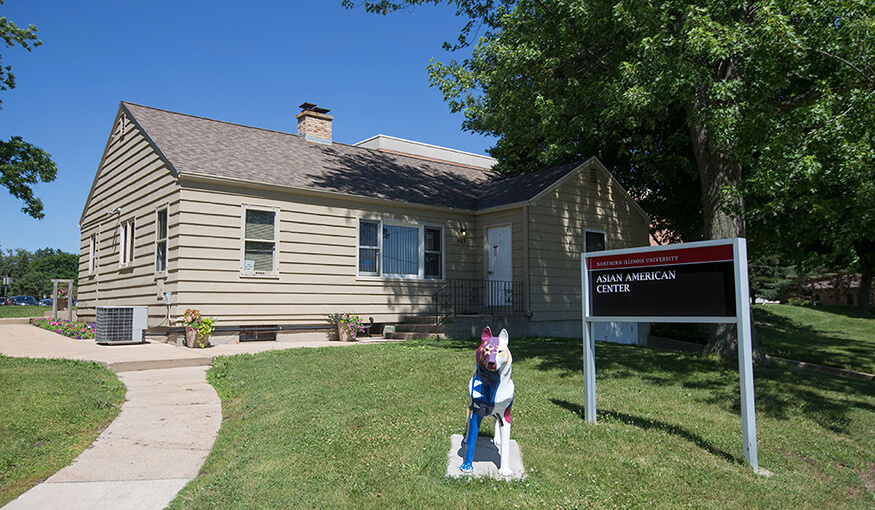
The Asian American Resource Center (AARC) was first housed in a “temporary” home at 429 Garden Drive known as the Jacob House – a formerly residential house donated to the university.  After fairly extensive renovations, the new center had about 1,500 square feet of usable space, which students and staff quickly filled with furniture and Asian décor.

Michelle Bringas, the center’s first and only director, called the establishment of a free-standing Asian American center “a defining moment in the university’s history.”

“We are taking the lead in Illinois with the first stand-alone Asian American center in the northern Illinois region,” Bringas said. “This is a visible space that our students can call home.”

The “temporary” home on Garden Drive remained the Asian American Center for 14 years. Meetings held in the facility were limited to just ten people or less, as that was the capacity of its largest room. For larger gatherings, Asian American students had to go to the Holmes Student Center.

In 2018, the Center relocated to the 375 Wirtz Drive, a building on campus that had been shared by University Health Services and campus police.  The new center provided a conference room, offices, a small kitchen and bathrooms – and capacity of about 50 – 80 people.

“Our goals remain the same,” said Bringas. “We want to hear that Asian American students come here at least in part because they hear about how well they’ll be supported. That brings joy to my heart.”

Click on photos to enlarge

The first home of the NIU Asian-American Resource Center, a small house at 429 Garden Drive. The Jacob House, as it was known, served as “temporary space” for 14 years.
In 2018, the Center was relocated to 375 Wirtz Drive, a building on campus that had previously been shared by University Health Services and campus police.
AARC Director Michelle Bringas with Robert and Doris Boey. In addition to being advocates for Asian and Asian-American students, the Boeys fund a program to support academic success, leadership and community service among Asian students.
Date posted: January 21, 2021 | Author: | Comments Off on Asian American Resource Center opens (2004)

Categories: