During the early years of the University Council, President Leslie Holmes had objected to the caucusing done by faculty prior to council meetings. But of course it continued, as faculty sought to concur on issues before a full Council vote.

In 1976 the faculty caucus assumed a more formal role as the Faculty Assembly, a group legitimized through constitutional amendment.

A decade later, following the University Council’s approval of extensive revisions to the University Constitution, the Faculty Assembly authorized University Council Executive Secretary Judith Bischoff to appoint a faculty task force to develop a proposal for a faculty senate at Northern Illinois University.

The group consisted of long-standing faculty members and university citizens of unimpeachable character: Dorothea Beard of Art; Gordon Dorn, also of Art; Dan Griffith of Biological Sciences; James Lankford of Communicative Disorders; Walter Owens of Physical Education; Eugene Perry of Geology, Gordon Schneider of Law, Jack Skeels from Economics; Linda Sons of Mathematical Sciences; Conard White of Technology and Harold Wright from Business.

The group met for months in the spring and summer of 1988; studied the constitutions of nearly 30 universities; and emerged with a plan for a true faculty senate at NIU. It was guided by two principals: proportional representation and disciplinary diversity. From the first came much broader representation and an increase to 75 members; from the second a request to be consulted in matters of university budgeting, facilities, long-range planning and proposed changes in administration.

And thus the Faculty Senate replaced the Faculty Assembly with broader representation, a more formal structure, and a specific mission as the “authoritative and official voice of the university faculty.”

J. Carroll Moody of History had been the chair of the assembly and was quickly elected to head the Faculty Senate. Moody went on to serve as executive vice president and provost in the 1990s.

Click on photos to enlarge.

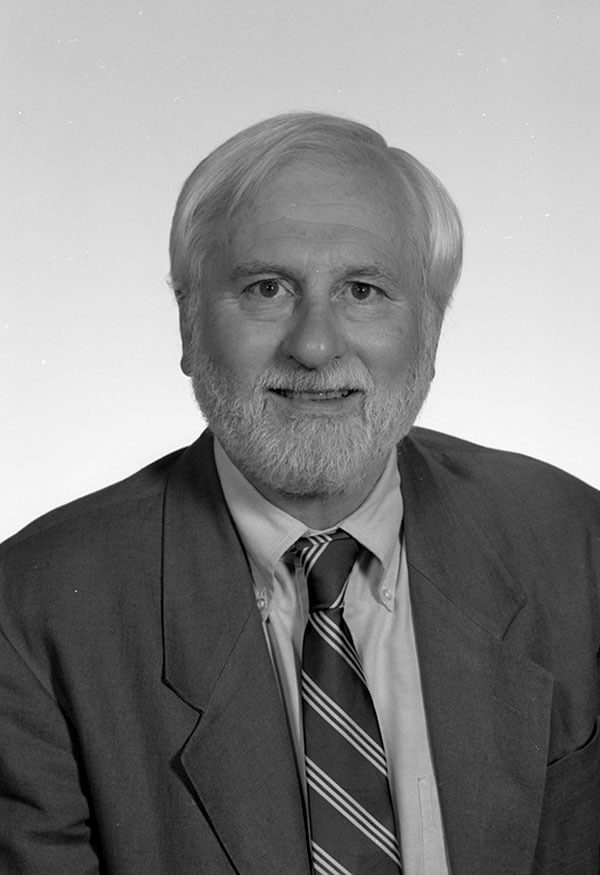
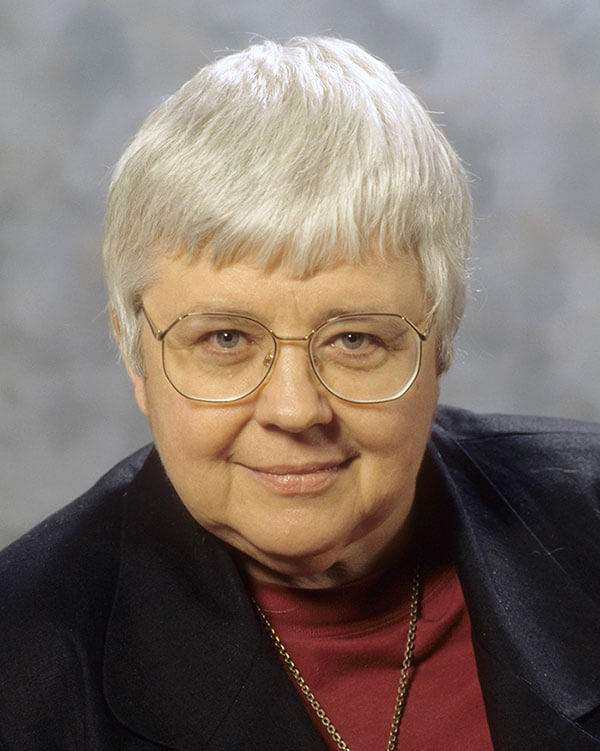
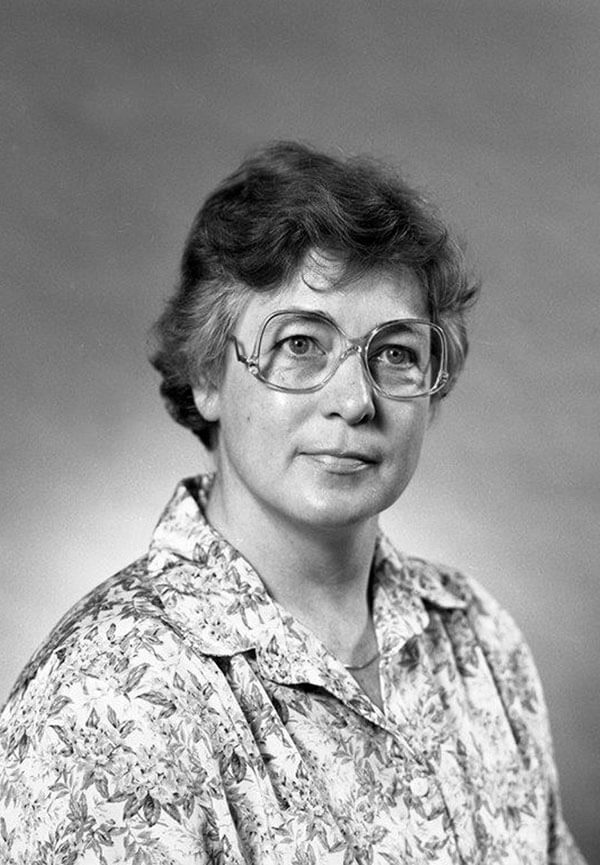
Judith Bischoff, professor of physical education, was Executive Secretary of the University Council and chaired a group that developed the NIU Faculty Senate.
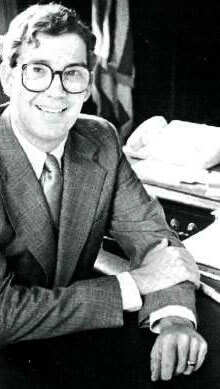
J. Carroll Moody, professor of history, was the first president of the new NIU Faculty Senate. Moody went on to serve as provost in the 1990s.
Date posted: October 9, 2020 | Author: | Comments Off on Faculty Senate established (1989)

Categories:

By any definition, Northern Illinois University women’s basketball reached dynasty status in the late 20th Century.

A quote from then junior Hall of Fame point guard Denise Dove in 1989-90 summed up the era:  “We were on a mission from the beginning.”

It was a blur of Huskie achievement, those 11 years under head coach Jane Albright and Liz Galloway-McQuitter (1984-95).  

The ultra-loyal Chick Evans Field House “Hoop Troopers” talked in their own language— with “C.O.”, “Double D”, “Light ‘Em Up Lisa”, “Charmo”, “Coach A” nicknames, all informal tributes to those NIU individuals and their aggressive style of play that created this gung-ho fan culture.  How better to share a Northern Illinois game—win or lose—by the players and coaching staff navigating “The Ring”—with fans lining four sides of the court in post-game, getting a hug, a handshake, or a high five.  It was the ritual in Evans.

How can one argue with six consecutive post-season tournament berths (five National Collegiate Athletic Association berths and one National Women’s Invitational Tournament appearance in 1989-95), one pre-season NWIT bid (1994-95), nine .500 or better campaigns, seven NCAA tourney games (two at home), five 20-plus victory seasons, four post-season league tournament championships (North Star Conference in 1990 and 1992, Mid-Continent Conference in 1993, and Midwestern Collegiate Conference in 1995), three regular-season loop titles (North Star Conference in 1989-90, Mid-Continent Conference in both 1992-93 and 1993-94), two regular-season Associated Press Top 25 national finishes (No. 17 in 1989-90 and No. 25 in 1992-93), two unbeaten conference years (12-0 in 1989-90 and 18-0 in 1993-94), and one undefeated home season (13-0 in 1993-94)?

The best quintet of these 11?  By consensus of the NIU Athletics Hall of Fame Selection Committee, Albright’s 1989-90 group was enshrined in 2005 and rightfully so.  It was the first women’s Huskie basketball NCAA team with a school-record 26 triumphs in 31 outings, the No. 17 final AP ranking, and the nation’s No. 1 offense (94.5 ppg. average with eight games over 100 points—including a record 122 vs. Valparaiso—and 11 more efforts with 90 or more).  Four of the five 1989-90 starters—Dove, guard Lisa Foss, forward Tammy Hinchee, and center Carol Owens—eventually made the Northern Illinois Hall of Fame as individuals.

Northern Illinois went 3-0 vs. the Big Ten Conference and defeated North Star rival DePaul three times (81-75, 92-77, and 97-85) that winter.  The first game in Chicago drew five busloads of NIU fans and marked the Huskies’ initial triumph in DU’s Alumni Hall, led by Hinchee’s game-high 35 points.  The Huskies also avenged the 76-61 setback to the Blue Demons in the 1989 NSC Tournament title game.

On February 15, 1990, the NIU-DU rematch at Evans drew a standing room only crowd of 6,118—the largest to see a women’s college game in the state at the time and biggest announced basketball crowd—male or female—ever at Evans.  As host of the NSC tourney on March 10, Albright and company beat DePaul again for the ticket to NCAA’s Big Dance and the Midwest Regional opposite No. 5 seed Texas Tech.  

With a combined 70 points from the four aforementioned NIU Hall of Famers, the Huskies upset TTU (84-63) before an impressive spring break crowd in Evans of 5,417 spectators on March 14.  Next was Purdue.  In a back and forth contest with 19 ties and 26 lead changes, the Boilermakers prevailed (86-81) on March 18 at Mackey Arena.

After the 1993-94 season, Albright was lured away by Wisconsin of the Big Ten and replaced by Galloway-McQuitter who kept the post-season string alive at six by beating UW-Green Bay, Notre Dame, and LaSalle in OT (80-77) for the MCC tourney crown on NIU’s home floor to capture the NCAA bid vs. Vanderbilt in 1994-95.

At NIU, Albright recruited or coached 14 of the program’s current 31 1,000-point career scorers.  She tutored one World Games participant (guard E.C. Hill), two Olympic Sports Festival players (Owens and Hill), one WNBA performer (Hill), six All-America picks, and four District Four All-Americas. Albright is one of nine members of the NIU Athletics Hall of Fame from that cage era.  Three of her Northern Illinois assistants—Sue Semrau (Florida State), Deb Patterson (ex-Kansas State) and Kamie Ethridge (Washington State) became Division I head coaches.

In addition to elevating the NIU program to a national level and generating unprecedented community interest, Albright upgraded Huskie schedules to feature such name, national opponents as Iowa, Tennessee, North Carolina State, Vanderbilt, Southern Cal, and South Carolina.

By Mike Korcek, Sports Information Director Emeritus

Click on photos to enlarge.

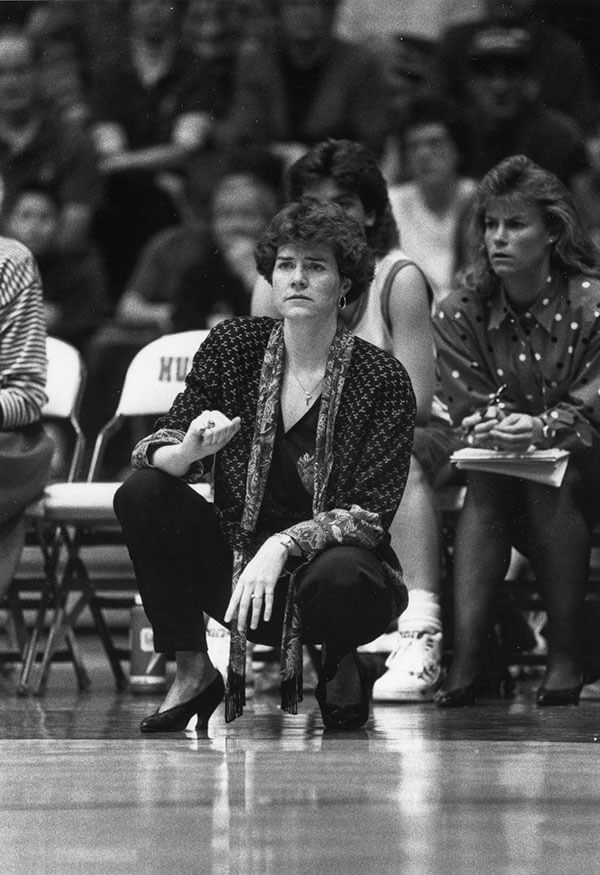
Coach Jane Albright led the Huskies for nine years, taking them to six consecutive post-season tournaments before being lured away by the University of Wisconsin.
Evans Field House was rocking whenever the Huskies were in town, and game attendance soared to record levels.
Women’s basketball developed a loyal following from campus and community. At the end of each home game, players and coaches walked around “The Ring,” where fans lined four sides of the court for hugs, handshakes and high fives.
Date posted: October 9, 2020 | Author: | Comments Off on Highest-ever attendance at a women’s basketball game achieved at NIU (1989)

Categories:

In November of 1990, Illinois Secretary of State Jim Edgar was elected governor of Illinois, succeeding his long-time predecessor, Jim Thompson. One of Edgar’s first major appointments was of Arthur Quern, a Chicago insurance company executive, as the new chair of the Illinois Board of Higher Education.

In October of 1991, Quern sent a letter to all public and private college and university presidents, introducing a new IBHE initiative called Priorities, Quality and Productivity, or PQP. 

Its purpose, Quern said, was to reallocate resources toward priority programs. What he didn’t spell out was that those priorities would be defined by IBHE staff, based on what those staff members and IBHE board members thought each institution’s mission should be. 

Statewide, the IBHE identified 190 programs that they recommended for elimination.

At NIU, 15 academic programs were on the IBHE’s chopping block: 

  • Ph.D. in Psychology
  • Ph.D. in Economics
  • Ph.D. in Geology
  • Ed.D. in Business Education
  • Ed.D. in Special Education
  • J.D. (College of Law)
  • Master’s in Special Education
  • Master’s in School Business Management
  • Master’s in Outdoor Teacher Education
  • Master’s in Business Education
  • Master’s in Journalism
  • Master’s in Russian
  • Master’s in German
  • Master’s in French
  • Master’s in Music History and Literature
  • Performer’s Certificate in Music

NIU’s Academic Planning Council responded by launching an intensive self-study of the so-called “hit list” programs. And while the APC looked inward, administrative staff mounted a massive external defense, such that some remember “having done little else” for several years.

Provost Carroll Moody insisted on being completely transparent with faculty in affected programs (most of whom had little familiarity with the IBHE or its machinations). He and Assistant Provost for Academic Planning Lynne Waldeland worked with faculty, chairs and deans to strategize responses to the board; Waldeland in particular devoted a tremendous amount of time coordinating responses and keeping the strategy on target.

Of all the programs NIU fought for, none required (or received) a bigger campaign than the College of Law.

As described in Chapter 8, NIU went around the IBHE to get legislative approval for the new college in 1978. Many, including former President Bill Monat, speculated that the IBHE went after Law during PQP as payback for their earlier defeat.  In any case, a spirited and broad-based defense of the College of Law by the university, alumni and the legal community ultimately removed the still-new college from the hit list.

In the end, NIU found ways to retain the curricula of several programs under attack by creating other structures, effectively giving up the name of a stand-alone program while still teaching the content (example, Master’s of German becomes Master’s in Foreign Languages with a specialization in German).

The Ph.D.s were successfully defended on the basis of being demonstrably important to the region. The number of community college instructors, community health leaders and K-12 administrators with doctoral degrees from NIU made a compelling case for retention.

In April of 1993, President La Tourette told the Faculty Senate that, as far as he was concerned, “we are finished with PQP by having met the targets the IBHE set out in terms of dollar and function reallocations.”

In reality, PQP dragged on for two more years, finally done in by the establishment in 1995-96 of independent governing boards. In his final State of the University speech in 1999, La Tourette said the university had “met a seemingly devastating challenge to our doctoral mission.”  We emerged, he said, with “a much greater appreciation internally for the unique identity of our Ph.D. programs.”

Click on photos to enlarge

Arthur Quern, a Chicago insurance executive, was the IBHE chair who led the PQP effort. Quern had been director of public aid and chief of staff under Gov. Jim Thompson.
The Illinois Board of Higher Education was created in 1961 to coordinate higher education in the state. The board has authority to approve new colleges and all new programs at public universities and community colleges, as well as make budget recommendations.
Carroll Moody was NIU provost during the PQP period. He insisted that faculty, typically far removed from the machinations of state government, be strongly involved in efforts to justify targeted programs.
Assistant Provost Lynne Waldeland did the heavy lifting to keep NIU’s strategies on target during PQP. Waldeland coordinated responses to the IBHE that emphasized regional needs and demonstrable achievements, including the many advantages of an affordable public law school in northern Illinois.

Date posted: December 2, 2020 | Author: | Comments Off on P-Q-P: NIU defends against threats to academic programs (1990)

Categories:

NIU can trace the history of its programs for disabled students to the 1970s. Following passage of the Rehabilitation Act of 1973, Dr. John Britton was hired as a faculty member in the College of Education and was named Director of Programs for the Physically Handicapped.

A former Olympic gymnast and swimmer from England, Britton became a paraplegic after a fall down stairs in his home. Confined to a wheelchair, he channeled his competitive energies into rehabilitation work around the globe, as well as preparing teachers to work with students with disabilities. In his university-level work, Britton identified physical barriers around campus, and worked to have them removed.

“Project Britton,” as it became known, was responsible for the lowering of water fountains and telephones; the installation of curb cuts and ramps, and creation of parking for the handicapped.

Britton also became an advisor to the DeKalb City Council, and in partnership with then-Mayor Judy King, worked to implement similar features in the city. 

From 1978 to 1992, separate offices assisted students with hearing impairments and those coping with other types of disabilities.

In 1980, the Office for Students with Disabilities was established in a small room on the first floor of the Health Services Building. Articles from the period seem to indicate that this small office focused on academic accommodations such as braille translations and lectures on cassette tape.

In 1990, passage of the Americans with Disabilities Act, or ADA, dramatically increased expectations. The ADA is a civil rights act that prohibits discrimination based on disability and it pushed universities to do better as a matter of law.

One of NIU’s first responses to ADA was merging the various offices serving disabled students – and so the Center for Access-Ability Resources (CAAR) was born. 

Nancy Kasinski directed CAAR for more than 30 years, pioneering the adaptive testing program and coordinating responses to individual student needs. She also saw it as part of the center’s mission to draw attention to the barriers presented by various disabilities, and to recognize disabilities as a form of diversity.

Over time, the small office on the first floor took over the Health Services Building’s  fourth floor. In 2012 CAAR was renamed the Disability Resource Center, and in 2019 the center moved to the Campus Life Building. Today the DRC serves nearly 1,000 students each year.

Click on photos to enlarge

The Americans with Disabilities Act (ADA) passed in 1990. Shortly thereafter, NIU formalized its various services for students with disabilities and established the Center for Access Ability Resources (CAAR). Nancy Kasinski was CAAR director for 30 years.
Date posted: December 2, 2020 | Author: | Comments Off on Disability Resource Center established (1990)

Categories:

In response to a 1989 University Council initiative, President John La Tourette created a program to recognize outstanding teachers in a manner comparable to the award program for researchers described in Chapter 9.

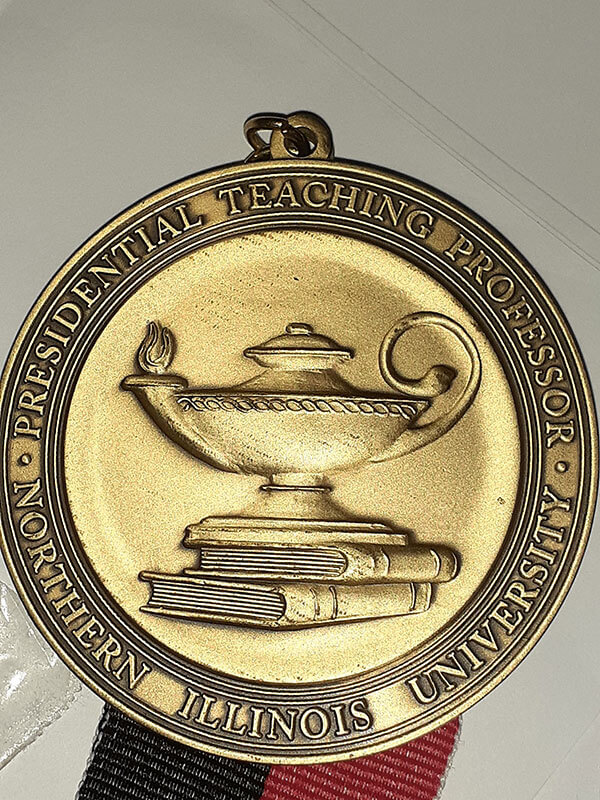
The first three Presidential Teaching Professors were named in 1991. They received a base salary increment, a stipend for their work over the following four years, and a medallion to wear with academic regalia. After their term was over, they became Distinguished Presidential Teaching Professors for life.

In a 1991 Alumni News article, the first three winners were asked for their philosophies on teaching:

Richard Baker, Accountancy

“I feel that a teacher must have, and must evidence, a real enthusiasm for learning before s/he can expect students to enthusiastically share in the learning experiences that are guided by the teacher.”

William Johnson, English

“Authentic education is not something carried on by a teacher for a student, or a teacher about a student, but by a teacher with a student. Through such a process both teacher and student are transformed.”

Robert Wheeler, Mathematics

“I believe in taking students where they are and building from there. I believe that one half hour of intensive dialogue with a caring and knowledgeable faculty advisor can change a student’s life.”

The first female PTP came along the following year: Mary Sue Schriber of English. Schriber joined the department in 1967 and set about to revise American Literature courses to include works by women writers.

Since the award’s inception, 80 faculty members have received the institution’s top teaching award.

Click on photos to enlarge

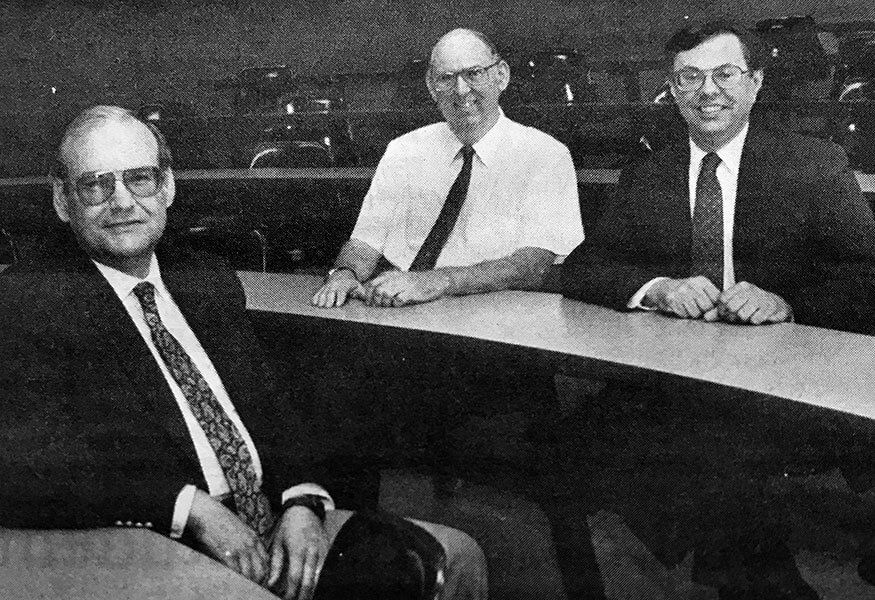
The first class of Presidential Teaching Professors included Richard Baker, Accountancy; Robert Wheeler, Mathematics; and William Johnson, English.
Mary Sue Schreiber of English was the first woman to be named a PTP in 1992.
The Presidential Teaching Professors receive salary increments, stipends for their work to improve teaching, and a special medallion to wear with their academic regalia.
Date posted: December 2, 2020 | Author: | Comments Off on First Presidential Teaching Professors named (1991)

Categories:

As far back as the 1930s, NIU offered classes off-campus. In high schools and church basements throughout the region, teachers and other professionals seeking advancement furthered their education. 

Eventually it became inefficient to offer programs in so many different locations, many of which lacked needed technology.  Some 3,000 students were taking 187 NIU courses in 34 different locations in the northwest suburbs when, in 1989, a study concluded that an ideal location for consolidating all of those classes would be somewhere along Route 59 between I-90 and I-88.

At the same time, Sears Roebuck and Company was looking to relocate its vast Merchandise Group central headquarters from the Sears Tower in Chicago to a suburban location. In 1990, the Village of Hoffman Estates gave Sears land for a development called Prairie Stone Town Center, and with urging from NIU alumni in Sears leadership as well as Village Mayor Michael O’Malley, Sears gave a portion of that land to NIU, already outfitted with parking space and utility lines.

For its part, NIU said new state funding would not be needed, as the $6 million building would be financed by a student “service delivery fee” for off-campus courses, as well as a lease-purchase agreement through First Chicago Corporation.

Arguments against the plan came from a number of private institutions operating in the area – most notably Roosevelt University. They feared competition from a public university able to offer courses at a significantly lower cost, but that very advantage eventually won the day. The Board of Regents approved the project in September 1990, followed by the IBHE in December.

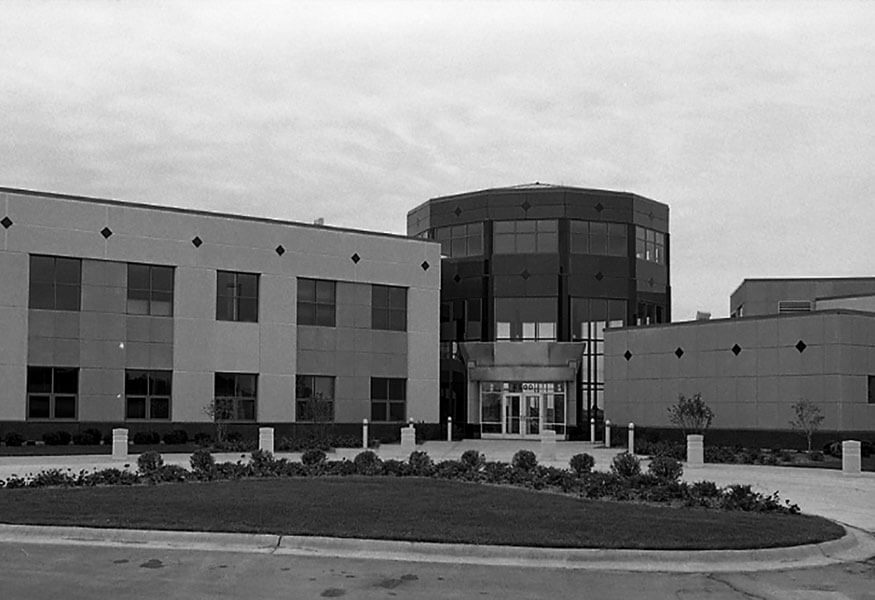
The Hoffman Estates Education Center (HEEC) is a 46,000 square foot facility with 23 classrooms, an auditorium, a library, two computer labs and staff and faculty offices.  It opened in fall of 1992.

Rockford

For NIU’s entire history, its close relationship with Rockford has been complicated. DeKalb beat out Rockford in the 1895 competition to site the new state normal school. Northern offered courses in Rockford since the 1930s, but over the years City leadership urged the university to establish a physical presence in the City of Rockford.

Actually, the proposal for an NIU Rockford Education Center originated not with NIU but with the Rockford state legislative delegation and the City of Rockford. Democratic State Senators Joyce Holmberg, an NIU alumna, and E.J. “Zeke” Giorgi and Republican State Representative John Hallock joined forces to gain approval and state funding for an NIU facility in Rockford.

Some controversy arose over the location of the Rockford center, with some favoring a downtown location and others a location near the Northwest Tollway (I-90). In the end, a ten-acre tract of land just off the tollway was donated to the university, and construction funds were released by Gov. Jim Edgar in January 1994.

The center was completed and opened in August 1995, with initial course offerings including graduate classes in business, engineering technology and education; a bachelor’s degree completion program in nursing, and courses leading to the bachelor’s in general studies.

Naperville

The final NIU regional education center to be built was the largest of the three. The population growth in DuPage County in the 1980s and 1990s far surpassed other areas in northern Illinois, and included a much larger concentration of college-educated, working adults than any other part of the state.

Several other institutions had already moved into DuPage County, and President LaTourette spent a great deal of time convincing those competitors (as well as the IBHE) that there were plenty of customers to go around.

While some pushed the idea of a single, multi-university center in DuPage County, LaTourette and his administrative staff created a business plan for an NIU facility that would include income from tenants and revenue-generating programs – no state money requested.

Among the first tenants who helped pay the bills were NIU’s Business and Industry Services (BIS); North Central Regional Education Laboratory (NCREL) and the East-West Corporate Corridor Association (EWCCA).

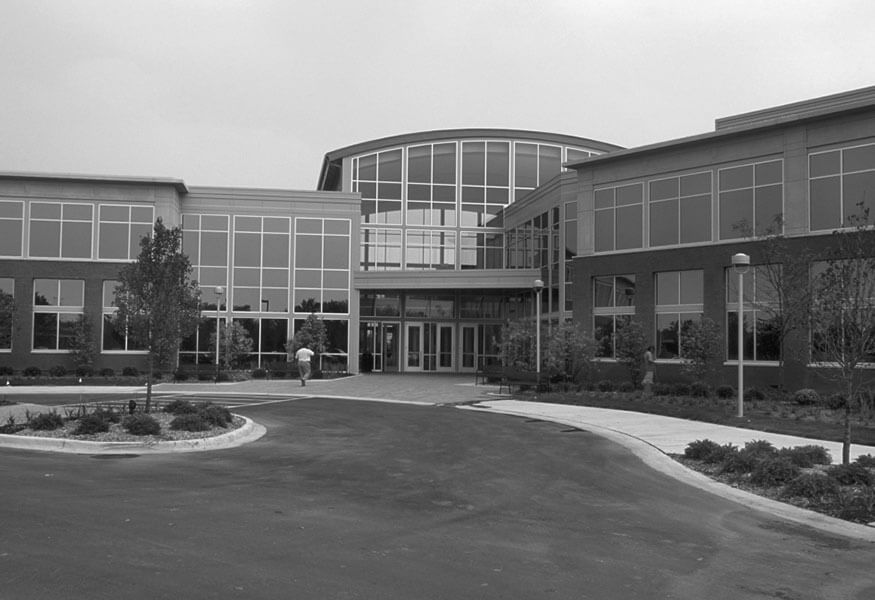
NIU-Naperville was constructed on 11.2 acres of land at 1100 E. Diehl Road at a cost of $20 million. It was a two-story building nearly three times the size of Hoffman Estates or Rockford at 114,000 square feet. 

In addition to the many modern, sunlit classrooms and computer labs, NIU-Naperville was built with revenue-generation in mind:  It featured a large auditorium and 4,500-square foot multi-purpose area for conferences, and a beautifully landscaped commons area, highly desired for weddings. It opened in fall of 2000.

Initial program offerings included master’s degrees in Business Administration, Finance, Computer Science, Public Administration and Education.

By 2010, all three centers were playing a critical role in strengthening NIU’s identity as a public institution engaged with its region. In 2013, the impact of these regional centers helped NIU win the inaugural Innovation and Economic Prosperity award from the Association of Public and Land-grant Universities (APLU).

Click on photos to enlarge

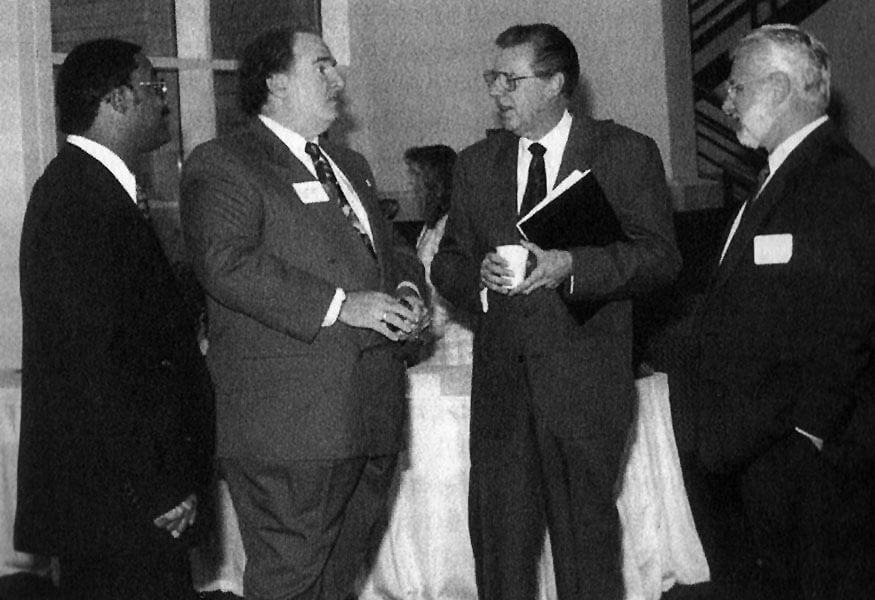
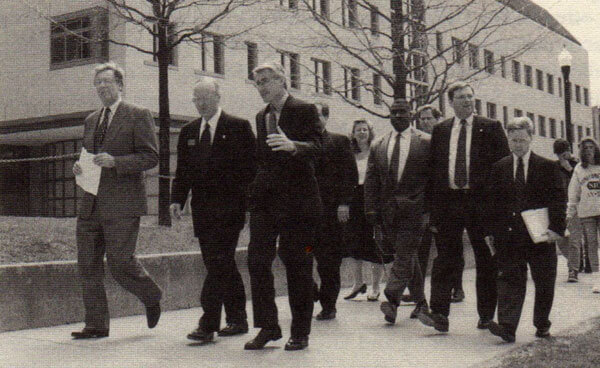
The Village of Hoffman Estates and Sears gave NIU the land on which HEEC is located. From left to right, Senior Vice President Eddie Williams, Hoffman Estates Mayor Michael O’Malley, President La Tourette and Steven Horvath, president of the NIU Foundation, talk at the facility’s dedication in 1992.
NIU’s Rockford Education Center is the only one of the three regional centers built with state dollars.
State Senator and NIU alumnae Joyce Holmberg pushed for state money to establish NIU – Rockford.
The last and largest of NIU’s regional centers opened in 2000 in Naperville.
Date posted: December 2, 2020 | Author: | Comments Off on First regional education center opens in Hoffman Estates (1992)

Categories:

Befitting its strong commitment to inclusion and diversity, Northern Illinois University turned to one of its own, naming alumna Cary Groth as director of intercollegiate athletics for the school’s (then) 16-sport, NCAA Division I program.

The historic announcement, made by NIU president John LaTourette on August 8, 1994, at a press conference at Holmes Student Center, led to a decade of significant Huskie athletics achievement during Groth’s tenure.

At the time, the 38-year-old Groth joined an elite group, i.e., Michigan State University’s Merrily Dean Baker and the University of Washington’s Barbara Hedges, as only the third female athletic director among the then 107 major-college institutions with an NCAA Division 1-A (now FBS) football program.  One week after Groth’s appointment, the University of Maryland’s Deborah Yow became the fourth 1-A woman AD.

“This is the biggest day in my professional life, being able to serve my alma mater in this capacity,” Groth said.  A two-sport NIU student-athlete (tennis in 1974-77) and basketball (1976-77), she would serve her beloved alma mater for 23 years as a coach, administrator, and AD.  In 2009, Groth was inducted into the NIU Athletics Hall of Fame.

President LaTourette’s introductory remarks turned out to be quite a prophecy.

“Cary will be an exceptional administrator who will be an outstanding leader and representative of NIU’s program,” LaTourette said.  “Our search confirmed what we knew, that besides having strong support within the program, she has an excellent national reputation with commissioners and athletic directors around the country.”

Among her major Northern Illinois accomplishments were (1) rejoining the Mid-American Conference after an 11-year absence (1997), (2) becoming one of the first eight major schools to make NCAA Certification (1995) and being re-certified (2000), (3) hiring head football coach Joe Novak (1996), (4) updating the graphic look of the Huskie mascot logo (2001), (5) upgrading or developing major facilities projects such as the Huskie Stadium East Grandstand (1995) and its FieldTurf surface (2001), the Convocation Center (2002), Ralph McKinzie Field (baseball), Mary M. Bell Field (softball), and the soccer complex.

Groth’s work on and off the field would garner national acclaim. 

In 2002, U.S. Secretary of Education Rod Paige, in noting the 30th anniversary of Title IX, named Groth to the Commission on Opportunity in Athletics, a blue-ribbon panel that examined “…ways of strengthening enforcement and expanding opportunities to ensure fairness for all college athletes.”

She was named among the “Super 50:  Women’s Sports Executives” by Street & Smith’s Business Journal (1998), the Administrator of the Year by the Women’s Basketball Coaches Association (2003), the Division 1-A Administrator of the Year by the National Association of Collegiate Women Athletic Administrators (2003), plus the recipient of the Gen. Neyland Achievement Award by the All-American Football Foundation (2002).

In addition, Groth served on the Commission on the Status of Women in Illinois (1998-2003), the National Association of Collegiate Directors of Athletics Board of Trustees, and NACWAA president (1994).

The double NIU graduate later became the AD at the University of Nevada-Reno (2004-13) where the Wolf Pack captured 13 Western Athletic Conference championships in seven different sports and won the school’s first WAC all-sports Commissioners Cup trophy (2006-07).  A four-sport athlete at suburban Rich East High School, Groth is retired and lives in Nevada.

By Mike Korcek, Sports Information Director Emeritus

Click on photos to enlarge

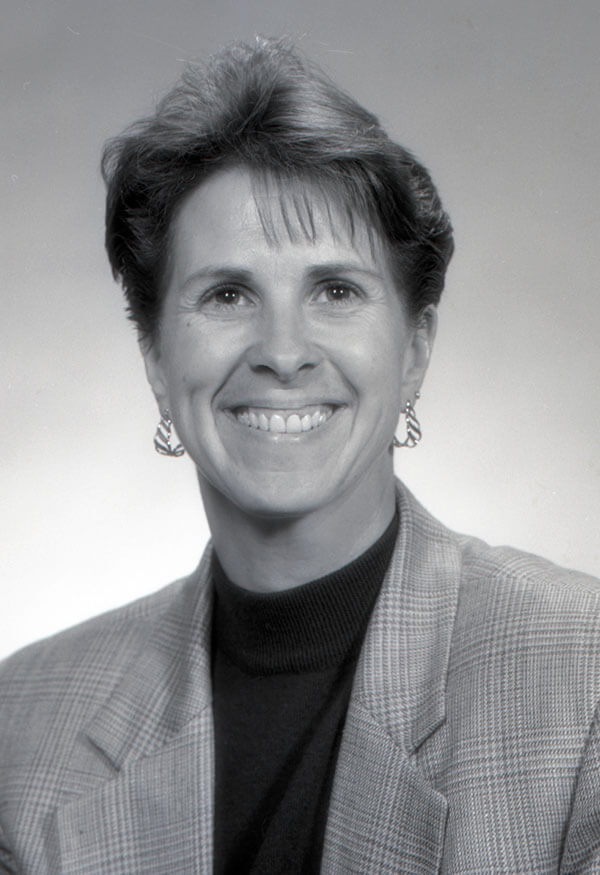
Groth was 38 when she was named AD. A two-sport athlete at NIU (tennis and basketball), Groth served her alma mater for 23 years as a coach and administrator.
One of Groth’s greatest accomplishments as AD was her support for now-legendary football coach Joe Novak. In the face of significant alumni and fan pressure, Groth held firm as Novak rebuilt the program “the hard way.”
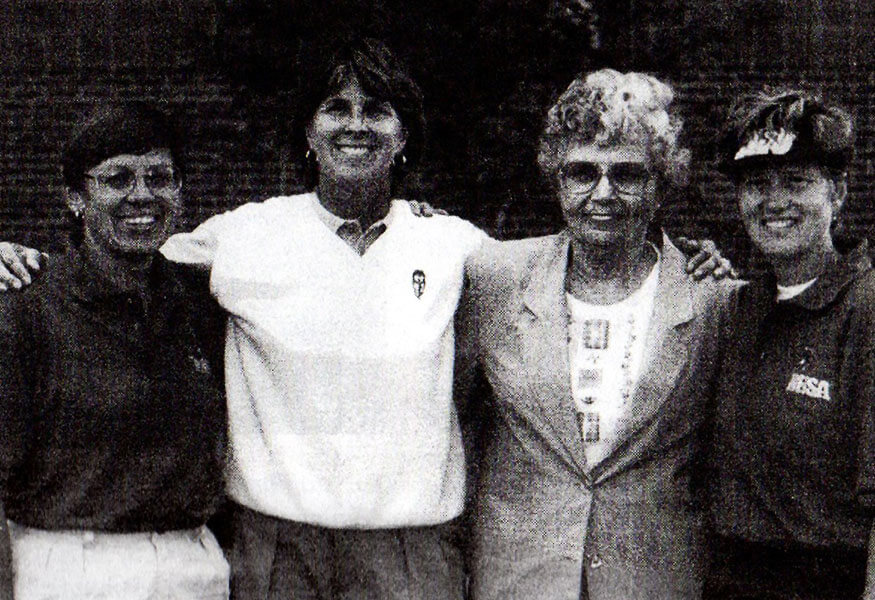
Groth was inducted into the NIU Hall of Fame in 2009. Here she poses with fellow Hall of Famers Dee Abrahamson, Mary Bell and Donna Martin.

Date posted: December 2, 2020 | Author: | Comments Off on First female athletic director named (1994)

Categories:

NIU had much to celebrate at the 100th anniversary of its founding.  A century after Northern Illinois State Normal School was signed into existence, the university it became made huge leaps forward in a single year. In 1995, NIU experienced –

  • establishment of an independent governing board
  • emergence of a stronger presence in Springfield and regional/national news media
  • a new effort to increase private giving – and receipt of what was then NIU’s largest-ever gift
  • a long-term commitment to a high-profile athletic conference
  • dedication of three major new buildings
  • release of state funds for the renovation of historic Altgeld Hall.

Not since its founding in 1895 had Northern seen so many historic events converge in a single year. It was fitting, then, that NIU’s Centennial celebration would be both an homage to its past and inspiration for its future.

For the DeKalb community, NIU hosted a number of events that celebrated its beginnings. Re-enactments of the dedication ceremony in 1895 and the laying of the cornerstone featured people in period attire. Early cars and horse-drawn buggies transported attendees to various events around campus.

The event most remembered from the 1995 celebration was the formal Convocation in the fieldhouse on Sept. 22.

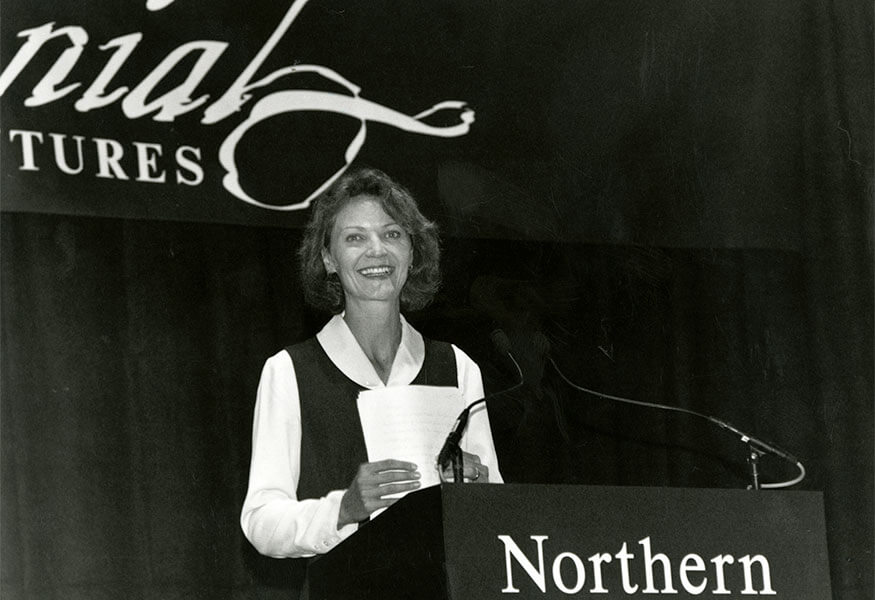
Hosted by Oscar-nominated actress and NIU alumnae Joan Allen, the event was a celebration of a mature university with a full complement of distinguished scholars.  Hundreds of them marched in full academic regalia; poet Lucian Stryk read a new work; Emeritus Music Professor Oscar Haugland composed an original piece, Overture for a Celebration, performed by the NIU Philharmonic and greeted by a lengthy standing ovation. 

For many in the standing-room only crowd, the highlight of the day was keynote speaker Carl Sagan, a planetary scientist made famous by his television series, Cosmos.

In addition to his keynote Is There Intelligent Life on Earth?, Sagan received an honorary degree from NIU and later participated in a lengthy question-and-answer session with members of the university community and public. A video of that exchange is linked below.

A number of other events commemorating the centennial took place during 1995, culminating in a gala at the then-new Navy Pier in Chicago. That event featured music, dance and theatre performances by current and alumni artists.

The Centennial was actually observed over the course of five years, celebrating both the founding of the institution in 1895 and the opening for its first students in 1899. During the intervening years, noteworthy Centennial events included NIU’s first modern  fundraising efforts, establishment of the Centennial Scholarship program, publishing of President Emeritus William Monat’s updated NIU history The Achieving Institution, establishment of the Centennial Fund for focused academic investments, and the naming of the All-Century Team for football and men’s basketball. 

Click on photos to enlarge

NIU alumnae and Academy-Award nominee Joan Allen emceed the Centennial’s capstone event. She praised NIU faculty members for their “lessons in creativity and life lessons in discipline, hard work, passion and compassion.”
Scientist, scholar and Pulitzer-Prize winning author Carl Sagan gave the keynote address at NIU’s Centennial Convocation. Later Sagan participated in a Q&A session in which he shared prescient views on the state of the environment and of science itself (see link below).
Renowned poet and Professor Emeritus Lucien Stryke gave a reading from his work that celebrated the intellectual life of the university.
Music Professor Emeritus Oscar Haugland composed an original piece for the Centennial, performed at the convocation by the NIU Philharmonic.
Date posted: December 2, 2020 | Author: | Comments Off on NIU celebrates its Centennial (1995)

Categories:

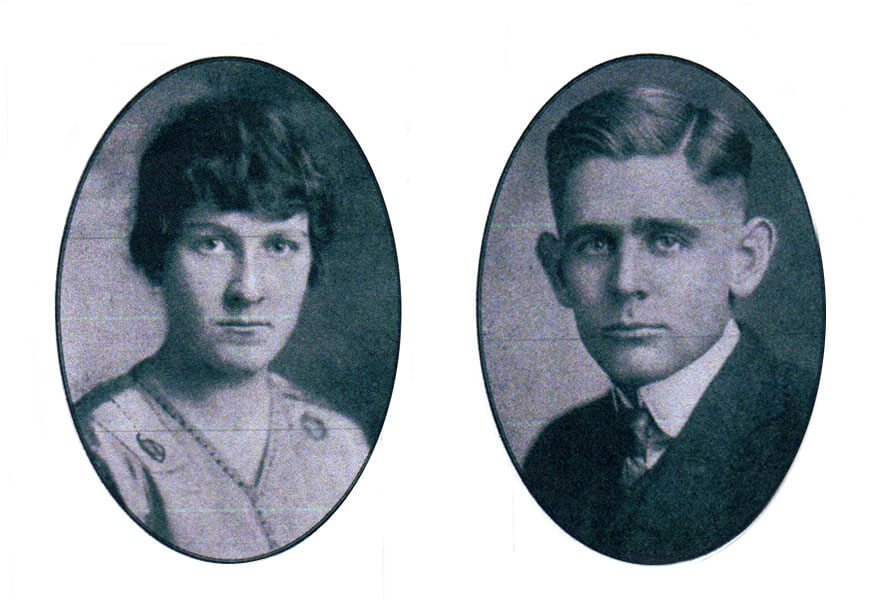
Among Northern’s earliest graduates were a couple named Ruth Gordon and LD Morgridge. She was from Oak Park, he was from Amboy, and they both worked on the  student newspaper and were active in the hiking club. After they graduated in 1915, Ruth and LD were married, and went on to careers in education: she taught in Sterling, Illinois, while he became principal of nearby Dixon High School.

Many years later, Ruth and LD’s son, John, became chairman of the board of Cisco Systems, a leading manufacturer of computer networking systems and software. Together with his wife, Tashia, (a teacher and author of books on learning disabilities), Morgridge chose to honor his parents with a gift to their alma mater.

“Investing in education is a natural fit with our belief in the importance of good teachers,” John Morgridge said, “and we can see that Northern is a premier training ground for teachers.”

The Morgridge gift of $1.7 million was, at the time, the largest ever received by NIU. It was targeted at improving teaching through technology, and included an additional $100,000 worth of computer equipment for the College of Education.

The Morgridge Endowment supports a faculty chair – NIU’s first such endowed professorship.

Note: An endowment exists in perpetuity. The principal is invested but never touched, while the annual income finances the endowment’s purpose. A story in Chapter 9 profiled the first named professorship, in which a funder renews its sponsorship on an annual basis.

Professor Donna Wiseman was the first LD and Ruth G. Morgridge Chair in Teacher Education and Preparation.

“Just as it was 100 years ago, and then again 50 years ago, we face a teacher shortage today,” Wiseman said. “An estimated two million new teachers will be needed nationwide during the next decade. And while the challenges they will face in the classroom will be many of the same faced by teachers throughout the last century, technology and diversity have sparked new conversations on teacher preparation for the 21st century.”

Click on photos to enlarge

Ruth and LD Morgridge were among Northern’s earliest graduates. In honor of his parents and their careers in education, Ruth and LD’s son John and his wife, Tashia, established the first endowed professorship at NIU.
Professor Donna Wiseman was the first LD and Ruth Morgridge Chair in Teacher Education and Preparation.
Date posted: December 2, 2020 | Author: | Comments Off on First endowed professorship created (1995)

Categories:

The call for independent governance from the dissimilar Board of Regents universities had gained traction by the 1980s. Even former Regents Chancellor and NIU President Bill Monat supported an end to the “system of systems,” expressing frustration with BOR efforts to keep NIU and ISU as similar as possible.

But it wasn’t just the system that Illinois’ public universities chafed against – it was the increasing power of an Illinois Board of Higher Education that favored private universities and the University of Illinois, but failed to provide any leadership to fight against seriously damaging budget cuts. 

In 1990, Jim Edgar was sworn in as governor.  Edgar, a graduate of Eastern Illinois University (and the only Illinois governor to have graduated from a public university other than the U of I), expressed an interest in revisiting the system of systems. Privately, many believed he was prompted by the IBHE’s abrupt and unexplained dismissal of his friend Stanley Rives, former president at EIU.

In fall 1994, the state general election brought in a Republican House majority. By early the following year, State Representative David Wirsing of DeKalb and State Senator Brad Burzynski of Sycamore had quickly re-introduced previously-failed bills allowing independent governance. In the fast-track period after the election, it took just 19 days of legislative consideration before the system of systems was a thing of the past.

Not content to leave such things to chance, President John La Tourette convinced Gov. Edgar to accept a bipartisan alumni screening process to review and recommend trustee candidates. In October of 1995, when Gov. Edgar announced his appointments to the NIU Board of Trustees, six out of seven came from the lists submitted by the alumni screening process. 

The legislation that created independent boards called for seven trustees on each governing body, with no more than four from the political party of the appointing governor and three from the other party. They serve six-year, staggered terms.

Two came from the former Board of Regents:  former Chicago labor leader Jim Myles, and Myron Siegel, a lawyer from Northbrook.

Others included Chicago lawyer Manny Sanchez, industrialist Bob Boey of DeKalb, banker George Moser of Hoffman Estates, Sears Vice President David Raymond of Glen Ellyn, and Rockford businesswoman Susan Grans.

Student Trustee Willie Fowler had also served on the Board of Regents. Student trustees were initially appointed by the Student Association, but later became elected by the study body at large.

Two of the new trustees (Siegel and Sanchez) were NIU alums. In the 24 years since the board was established, some 24 men and women have served as appointed trustees, while 25 have served one-year elected terms as voting student trustees.

President John La Tourette hailed the new board and NIU’s new ability to create its own future. “We now have a board that really represents and understands the region we serve – who our students are, what they need, and how partnerships with government, business, industry and other concerns can help us further our mission.”

Click on photos to enlarge

State Senator Brad Burzynski (L) and State Representative David Wirsing championed independent governance for NIU, introducing the bill that made it a reality.
Governor Jim Edgar, shown here on a campus tour, supported a break-up of the “system of systems,” and quickly signed the legislation that gave Illinois’ public universities their own governing boards.
Date posted: December 2, 2020 | Author: | Comments Off on NIU gets its own independent governing board (1996)

Categories: