NIU Logo
  • Home
  • Key Moments
    • Chapter 1: The Beginning
    • Chapter 2: Growth, Development – and War
    • Chapter 3: Growth in Challenging Times
    • Chapter 4: Birth of a University
    • Chapter 5: Entering the Modern Era
    • Chapter 6: Charting a New Course
    • Chapter 7: Courage and Confrontation
    • Chapter 8: The Expanding Mission
    • Chapter 9: Celebrating Excellence and Self-Determination
    • Chapter 10: Independence, Milestones and Expansion
    • Chapter 11: Philanthropy, Prestige and the Darkest Hour
    • Chapter 12: Challenge, Achievement and Resilience
  • About
    • The 125 Key Moments Selection Committee
    • Selection Criteria
    • Credits
    • 125th Anniversary Website

Home / Chapter 6: Charting a New Course / Calder’s sculpture Le Baron is installed (1967)

1
2
345678910
Calder’s sculpture Le Baron is installed (1967)
Le Baron, a nickel steel-plate stabile by Alexander Calder, stands on a cement pad just behind Lowden Hall on NIU's east campus.

The New University called for by President Rhoten Smith would celebrate the life of the mind in all its many expressions. In the run-up to Smith’s inauguration, planners empaneled a committee of experts to identify a piece of public art that would symbolize NIU’s evolving aspirations. 

In the 1960s, Alexander Calder was arguably America’s foremost sculptor, and one of the best-known artists in the world. He was the inventor of the mobile, a type of kinetic sculpture that delicately balanced suspended components that moved in response to air currents. He also created stationary sculptures called stabiles, or large-scale fixed versions of the mobiles. These monumental abstract sculptures were installed in urban spaces around the world, including the huge red-painted stabile called Flamingo in the Federal Center Plaza in Chicago.

Le Baron, a contemporary nickel steel-plate stabile sixteen feet high and fourteen feet wide, was first displayed at the Maison de la Culture in Bourges, France. It was deconstructed there, shipped to DeKalb, and then reassembled atop a special concrete pad on the pedestrian quad between Lowden, Davis and Montgomery Halls and the East Lagoon. Calder himself chose the location after studying maps and photos of the campus.

The sculpture was purchased for $50,000 (the equivalent of nearly $370,000 today), and is now valued at more than a million dollars. It was paid for by donors, the Student Association, and a loan from the NIU Foundation (repaid by revenue from campus vending machines).

Le Baron was dedicated on May 23, 1967, as part of the weeklong celebration of NIU’s new president.  

Click on photos to enlarge

Alexander Calder poses with Le Baron outside the Maison de la Culture in Bourges, France, where the sculpture was displayed before coming to NIU.
President Smith passed Le Baron every day as he came and went from his Lowden Hall office. Alexander Calder himself chose the location for his giant stabile after studying maps and photos of the campus.
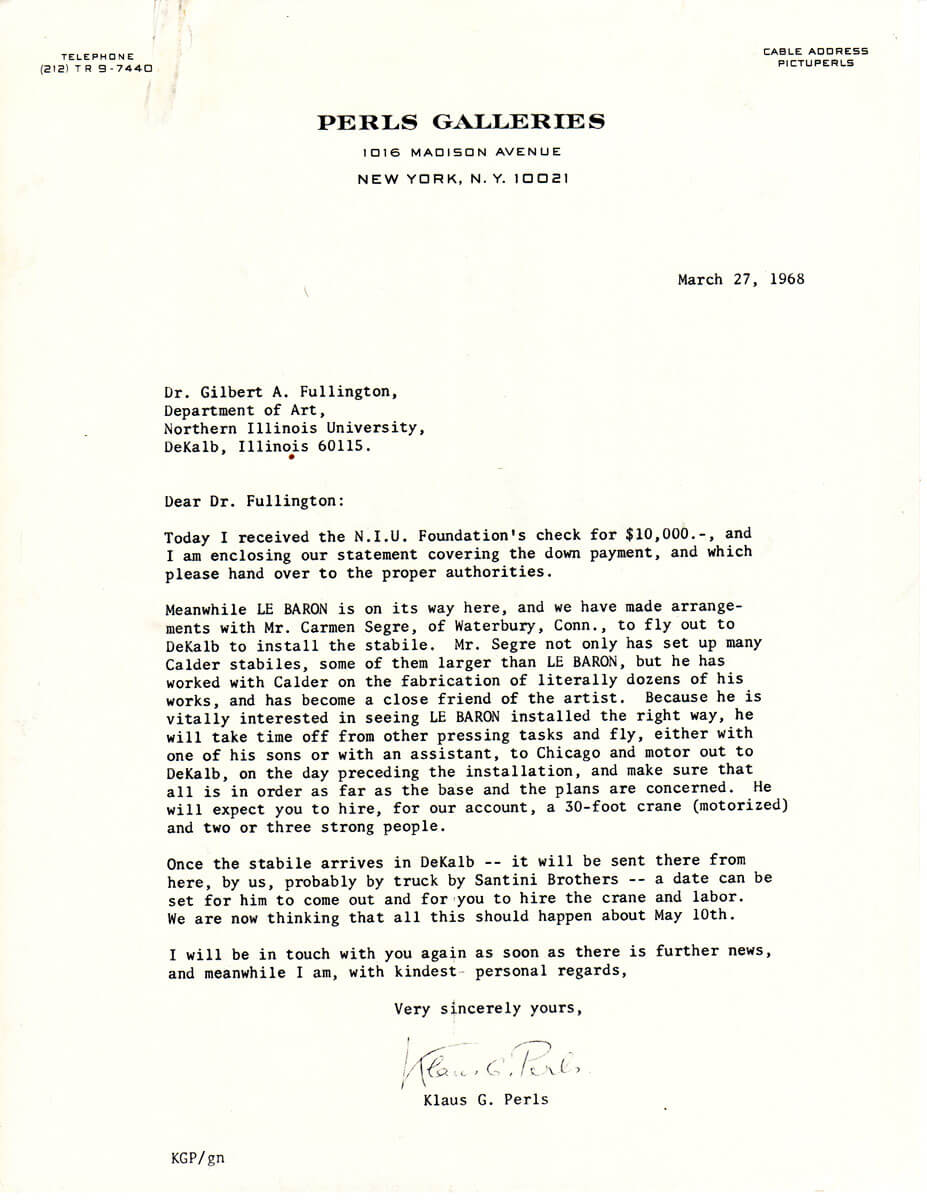
A letter from the Perls Gallery in New York explains how the installation will be done.
An article in the April 1968 NIU News provided an overview of the project.
The dedication of Le Baron capped off a week-long celebration of Rhoten Smith’s inauguration. This program is from the dedication event.

1
2
345678910
Follow us on FacebookFollow us on TwitterShare this post via emailPrint this post
Celebrate With Us

Visit www.niu.edu/anniversary.

Connect With Us
Follow us on Facebook Follow us on Twitter Follow us on LinkedIn Follow us on Instagram
Learn More About NIU

Visit www.niu.edu.

© 2026 Board of Trustees of Northern Illinois University. All rights reserved. Privacy Notice
Working...please wait
Loading spinner