
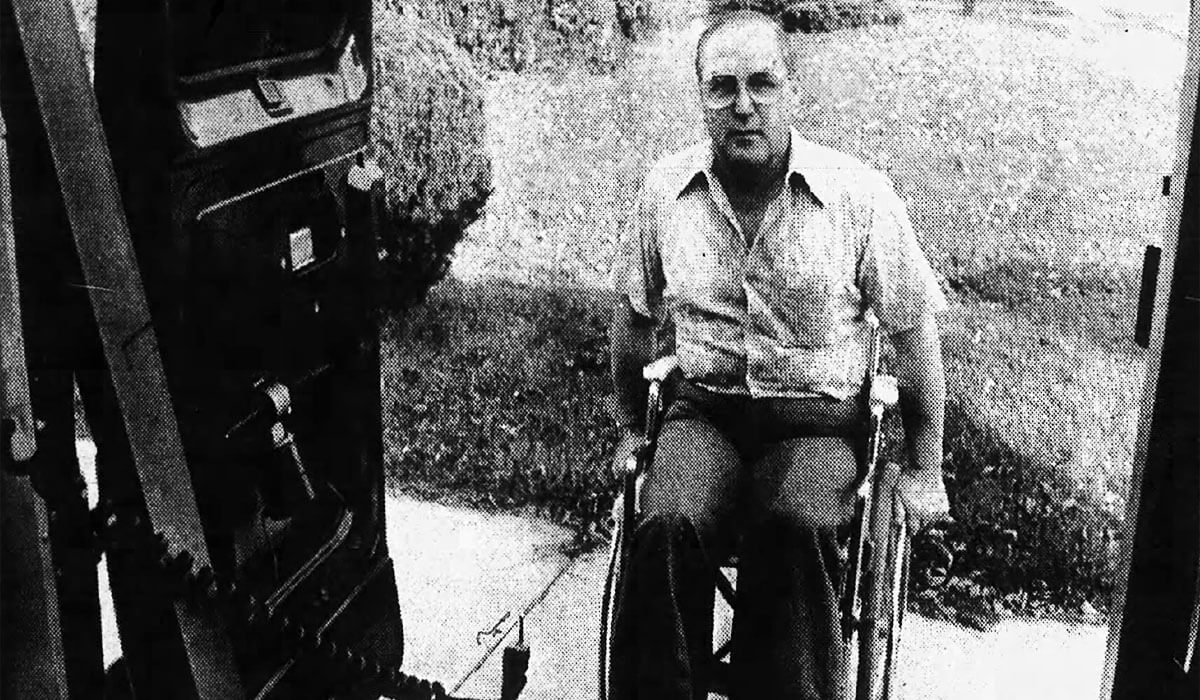
NIU can trace the history of its programs for disabled students to the 1970s. Following passage of the Rehabilitation Act of 1973, Dr. John Britton was hired as a faculty member in the College of Education and was named Director of Programs for the Physically Handicapped.
A former Olympic gymnast and swimmer from England, Britton became a paraplegic after a fall down stairs in his home. Confined to a wheelchair, he channeled his competitive energies into rehabilitation work around the globe, as well as preparing teachers to work with students with disabilities. In his university-level work, Britton identified physical barriers around campus, and worked to have them removed.
“Project Britton,” as it became known, was responsible for the lowering of water fountains and telephones; the installation of curb cuts and ramps, and creation of parking for the handicapped.
Britton also became an advisor to the DeKalb City Council, and in partnership with then-Mayor Judy King, worked to implement similar features in the city.
From 1978 to 1992, separate offices assisted students with hearing impairments and those coping with other types of disabilities.
In 1980, the Office for Students with Disabilities was established in a small room on the first floor of the Health Services Building. Articles from the period seem to indicate that this small office focused on academic accommodations such as braille translations and lectures on cassette tape.
In 1990, passage of the Americans with Disabilities Act, or ADA, dramatically increased expectations. The ADA is a civil rights act that prohibits discrimination based on disability and it pushed universities to do better as a matter of law.
One of NIU’s first responses to ADA was merging the various offices serving disabled students – and so the Center for Access-Ability Resources (CAAR) was born.
Nancy Kasinski directed CAAR for more than 30 years, pioneering the adaptive testing program and coordinating responses to individual student needs. She also saw it as part of the center’s mission to draw attention to the barriers presented by various disabilities, and to recognize disabilities as a form of diversity.
Over time, the small office on the first floor took over the Health Services Building’s fourth floor. In 2012 CAAR was renamed the Disability Resource Center, and in 2019 the center moved to the Campus Life Building. Today the DRC serves nearly 1,000 students each year.
Click on photos to enlarge