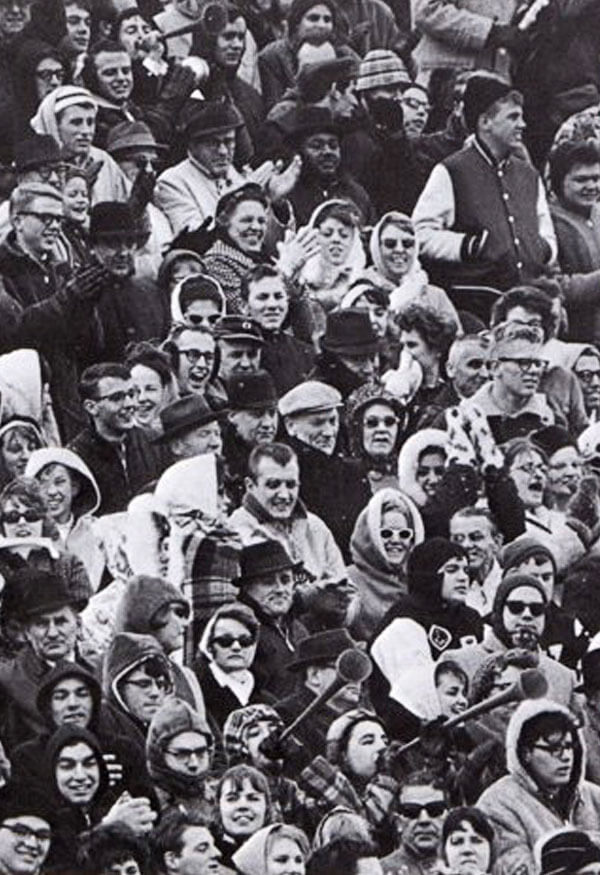

As the tidal wave of Baby Boomers hit campus in the 1960s, NIU head football coach Howard Fletcher started a streak of nine consecutive winning seasons highlighted by conference championships in 1963, 1964, and 1965, Mineral Water Bowl appearances in 1962, 1963, and 1965, and, of course, the spectacular 10-0-0 season that earned College Division National Championship designations from both the Associated Press and National Association of Intercollegiate Athletics polls in 1963. Fletcher’s success eventually provided the impetus for elevation to NCAA University Division status in all sports.
In this era, Fletcher and his Little All-America quarterback George Bork first became local household words, then national media darlings synonymous with the forward pass. Bork and NIU repeated as both individual and team statistical national passing yardage kingpins, and Bork became the first collegiate passer to throw for 3,000 yards (3,077, to be exact) in a single season at any level of American football.
During that magical 1963 season, Bork was featured in Sports Illustrated, Time, The Christian Science Monitor, the New York Daily News, plus in Chicago’s American by a young sportswriter named Brent Musberger.
At the time, the 1963 Huskies were the most talented group in NIU history. Alumni and fans wanted NIU to capitalize on that success, and that meant upgrading facilities. Sports media of the era called the campaign for a new stadium “the house that Bork built.”
Rustic, cozy, 5,500-seat Glidden Field, NIU’s gridiron home since the school’s origins and located east of Gilbert Hall where the art and music buildings are now, struggled to accommodate some of the five-digit attendance figures in Fletcher’s sideline heyday. It was outdated and not to NCAA University Division or Mid-American Conference standards.
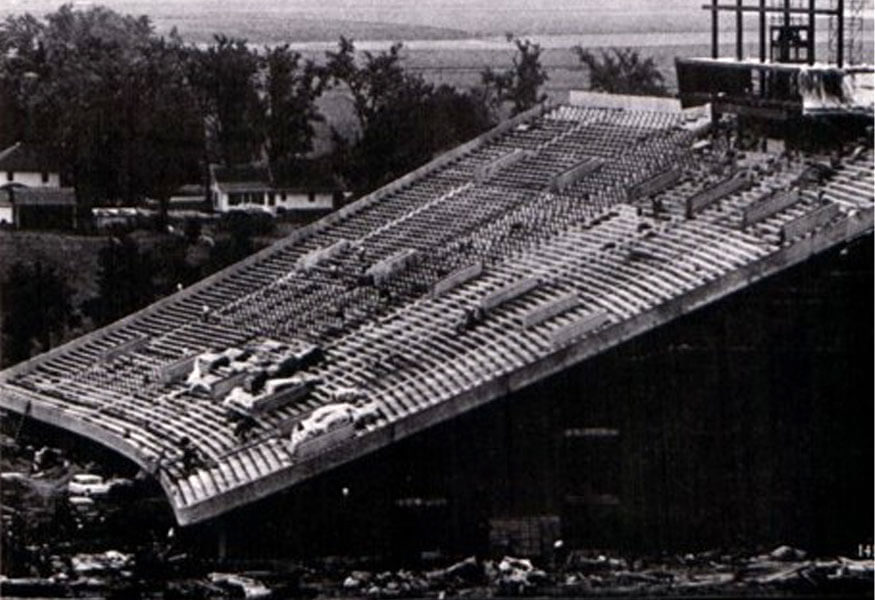
NIU athletics director George “Chick” Evans started lobbying for a west campus facility that would house not only student-athletes but future physical education teachers (rationalization for the three teaching gyms originally underneath the West Grandstand). Behind the scenes, the planning had started, and on January 30, 1964, a groundbreaking ceremony took place.
Designed by architects Holabird and Root of Chicago, the stadium was built by Peterson-Roberts Construction of Rock Island, Ill, at a cost of $2,265,172 in 1965 bond revenue dollars. The natural grass surface lasted four seasons before AstroTurf was installed in 1969, 1980, 1990, and then FieldTurf in 2001 and 2009. The East Grandstand was added in 1995 at a cost of $4,000,000. Significant 21st century additions include the Yordon (2007) and Chessick (2013) centers. The seating capacity of Huskie Stadium has varied from the original 20,257 figure to 31,000 in 1995 with the end zone bleachers to the current 23,595.
Due to construction delays, NIU played the first three home games of its 1965 schedule at Glidden Field. Finally, on November 6, 1965, the 20,257-seat west campus superstructure was dedicated on Homecoming / “Legislator’s Day” with a 48-6 triumph over Illinois State behind one of Bork’s successors at QB, Ron Christian, before 18,856 spectators that included an impressive VIP guest list of state and local politicians.
As part of the university’s 75th anniversary observance in May, 1974, it was officially named “Huskie Stadium” by NIU President Richard Nelson and a local blue ribbon committee. In subsequent years, players and coaches affectionately nicknamed their home “The Doghouse.”
(By Mike Korcek, former Sports Information Director, retired.)
Click on photos to enlarge