NIU’s exponential growth in the 1960s made every organizational process more complex – records administration, payroll, student and personnel records, research, partnerships and many other day-to-day activities were moving beyond the ability to keep track of things by hand.

NIU leased its first computer from IBM in 1962. The IBM model 1620 came with technicians to teach faculty and staff how to use it. The early mainframes were huge and required large, temperature-controlled rooms. The entire campus shared one computer, with various colleges and departments vying for time on the giant machine.

In 1967, NIU upgraded to the legendary IBM 360, a room-sized collection of whirring machines with giant tapes – prominently featured on the popular series “Mad Men.”

In addition to administrative functions, the 360 was heavily used by Math and Computer Science for computer language development, and by Biological Sciences, Geology and Political Science for a variety of research projects.

Computing power and its access became increasingly important for all facets of university operations – instruction, research and administration. By 1979 it was clear that NIU needed more computing power, but the IBM model that would have met university specifications could not be upgraded internally (and would require the construction of a new water-based cooling component.) Instead, NIU went with an IBM spin-off company and purchased the Amdahl 470.

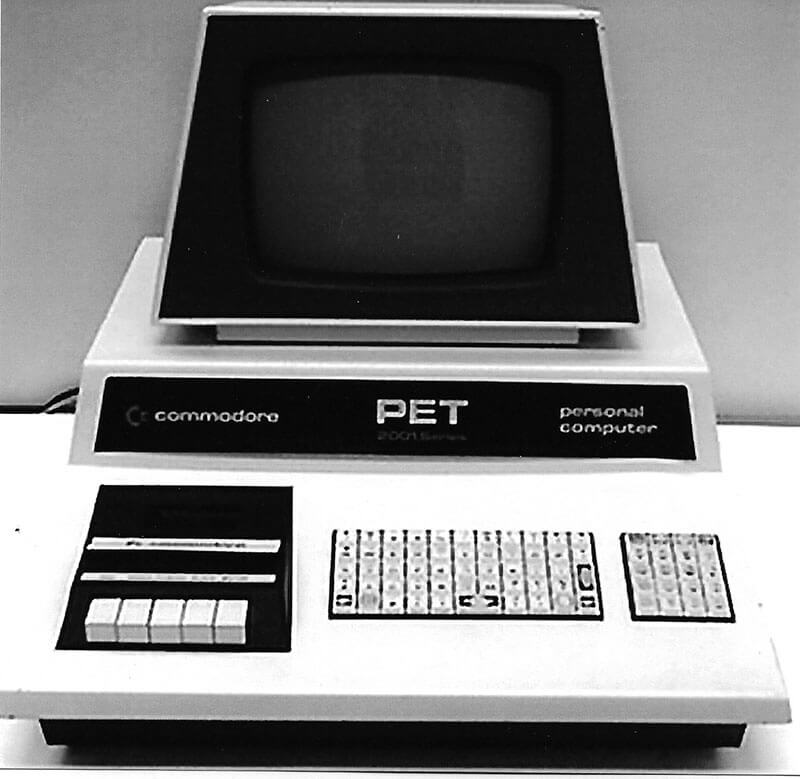
With the increased power offered by the 470, NIU was able to improve many administrative computer functions, including enrollment, grades, and bursar and personnel functions. NIU’s first personal computer arrived in July of 1978: A Commodore PET with a cassette tape drive and featuring 4K RAM, a seven-inch momochrome CRT, and a five by seven-inch keyboard. It cost $711 new, and now resides in the NIU Archives.

Click on photos to enlarge

Math majors Martha Flesher and Diane Homewood work together on the IBM machine in the Altgeld Hall computer center to solve a series of coding problems.
NIU’s first personal computer arrived in 1978: A Commodore PET with a casette tape drive and 4K of RAM. It cost $711 new, and now resides in the NIU archives.
Date posted: May 17, 2020 | Author: | Comments Off on NIU obtains its first computer (1962)

Categories:

The post-war enrollment boom brought new student demands for more, better and bigger facilities: more residence halls, expanded library space, bigger classroom buildings – and more than anything else, a place for students to gather.

Two decades earlier, an enterprising young man named Jim Lundberg had planned and built on the river bank across the bridge a “handy and pleasant eating establishment” known as Jimmie’s Tea Room. From the time it opened in 1940, Jimmie’s was the place to be for a hamburger, Coke, and conversation. At the end of the war, the university purchased the building, renamed it the College Tea Room, and enlarged it into a student union where dancing and other activities were possible.

Yet the huge influx of new post-war students quickly made it clear that NIU had outgrown the Tea Room. President Holmes empaneled a university center committee whose members began planning a facility that could accommodate an enrollment of at least 10,000.

The center was to be a “center for the community life of the college,” “a hearthstone,” and a unifying force that would hold the university together as it grew larger. A University Center Board was created to administer the many programs aimed at satisfying cultural, social and aesthetic needs of the university community.

When the University Center opened in 1962, the local paper reported on “the swank Pheasant Room,” “plush faculty lounge,” and the president’s “penthouse suite.”

The Center was a hit with students, who now had a place to relax in lounges, have fun in bowling alleys, meet friends in the cafeteria, hear speakers in the auditorium and see performers in the ballroom.

So popular was the facility that its size was doubled within a few years, and a 15-story tower added, creating the campus’s most noticeable landmark. On May 21, 1968, the addition — with the showcase Carl Sandburg Auditorium — was dedicated as part of President Rhoten Smith’s week-long inauguration celebration. Speakers included Sandburg’s granddaughter and Chicago legend Studs Terkel.

Students lobbied for additional services at the Center, and eventually the Board voted to permit the inclusion of a university-owned bookstore, and in later years allowed private partners such as fast food franchises.

In 1974, the Board voted to name NIU’s most popular gathering place in honor of Leslie A. Holmes, the president whose persistence had made it a reality. But other than the new name, not much changed at the Holmes Student Center for more than half a century.

Finally in 2018, a long-awaited renovation began that completely reimagined the entire first floor, adding two new restaurants, a Starbucks coffee shop, a new bookstore and offices for key student organizations. Thousands of square feet of new space is devoted to places where students can lounge, study and collaborate.

During warmer weather, the patio area outside of the newly created ground-level entrance extends the lounge space outdoors. That entryway also reflects changes aimed at making the entire ground floor accessible to people with disabilities, as do two new elevators and ramps throughout.

As the HSC approaches its 60th birthday, it has been given new life as a modern hearthstone for a new generation.

Click on photos to enlarge

Jimmie’s / The College Tea Room served as student union from the 1940s through the early 1960s.
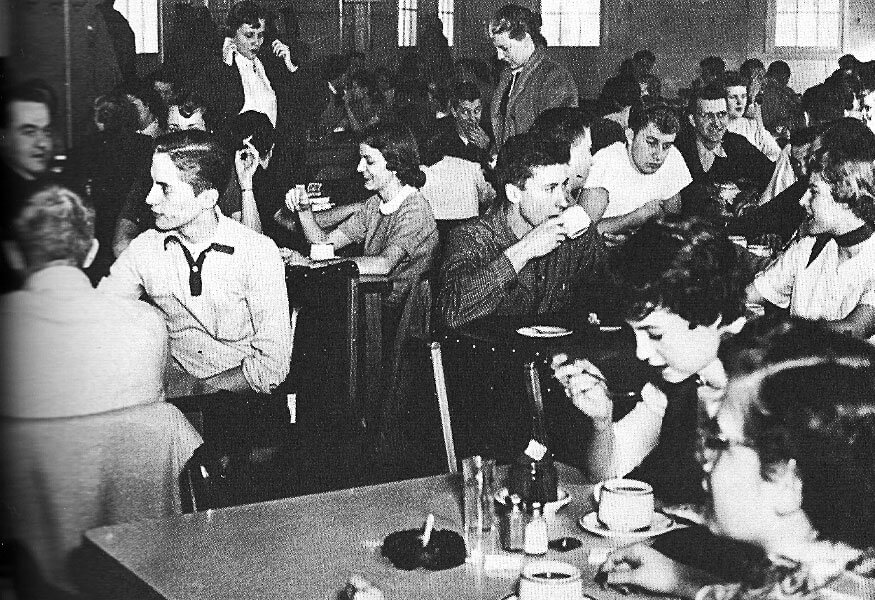
Here students in the 1950s enjoy a meal in the campus cafeteria, located in one of the repurposed barracks in “Vetville” along Garden Road.
One of the most popular features of the new Student Center was the Huskie Bowling Alley.
The showpiece of the new University Center was state-of-the-art Carl Sandburg Auditorium.
The Center added two additions over the years, doubling programming space and bringing a 15-story hotel tower.
Date posted: May 17, 2020 | Author: | Comments Off on University Center is completed (1962)

Categories:

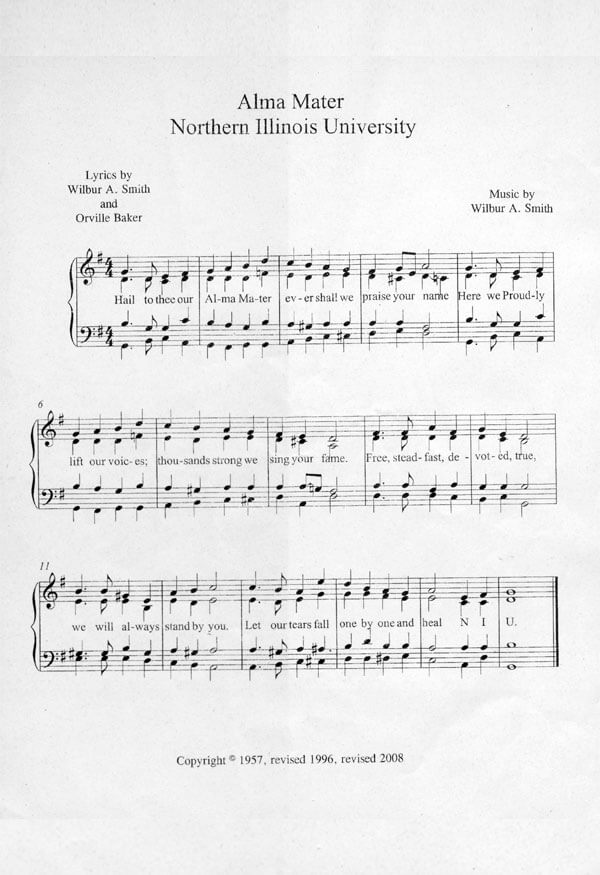
Like the Huskie Fight Song, NIU’s beautiful “Alma Mater” traces its origins to a tune by the same name written by music professor Neil Annas, who served as department head from 1912 to 1951. And like the fight song, Northern’s various name changes over the years necessitated some serious adjustments to both melody and lyrics.

The updated version of the Alma Mater was written by former NIU band director Wilbur Smith with help from English professor Orville Baker in 1957. It was first performed at a campus Pops Concert in January of 1961, and was officially adopted in 1963.

The Alma Mater was a favorite recital piece, and many different NIU musical ensembles performed it at concerts in the 1960s, 70s and 80s. But the somber hymn fell into disuse in later years, replaced at many events by its livelier cousin, the Huskie Fight Song. Finally in the 1990s, university leadership decided to revive campus knowledge of the song by having it played each day at noon by the carillon, or bell tower, atop the Holmes Student Center.

Hail N.I.U. – Alma Mater

Hail to Thee, our Alma Mater
Ever shall we praise your name
Here, we proudly lift our voices
Thousands strong we sing your fame:
Free, steadfast, devoted, true
We will always stand by you
Let our cheers resound for Northern
Hail, N.I.U.

Lyrics by Wilbur Smith and Orville Baker

Music by Wilbur Smith (revised from original by A. Neil Annas)

Click on photos to enlarge

Former band director Wilbur Smith significantly rewrote the Alma Mater (originally penned by Neil Annas) to accomodate the school’s name change.
English Professor Orville Baker is credited with helping Smith with the lyrics.
In 2008, the song’s final line was edited for use at a community-wide 2/14 memorial service.

Date posted: May 17, 2020 | Author: | Comments Off on Alma Mater song officially adopted (1963)

Categories:

On October 14, 1960, John F. Kennedy stood before a crowd of 10,000 on the steps of the union at the University of Michigan in Ann Arbor. It was 2 a.m., and Kennedy was exhausted from a full day of presidential campaigning. Yet he took the opportunity to tell the gathered crowd about an idea he had for a new type of world diplomacy called the Peace Corps.

The Peace Corps – and NIU’s enthusiastic response to it – is responsible for starting the university’s connections to southeast Asia, and its reputation as a world leader in southeast Asian culture, politics and art.

In 1961, NIU successfully negotiated a contract to train Peace Corps volunteers. By 1968, the university had played host to more than 700 Peace Corps trainees headed for Southeast Asian countries, specifically Malaysia, Thailand and the Philippines – areas considered critical to continued American security.

Among the faculty who lead this effort were Norman Parmer and J. Patrick White of History; Political Science professors Allen Dionisopoulos, Daniel Wit and Ladd Thomas, as well as Business professor Don Arnold. Together this group provided the foundation for what became one of the nation’s leading centers for Southeast Asian programs.

On March 5, 1963, the Illinois Board of Higher Education approved the establishment of NIU’s Center for Southeast Asian Studies. In September of that year, Ladd Thomas was named the Center’s first CSEAS coordinator, a position he held until 1971.

While the Center initially concentrated on Malaysia, Thailand and the Philippines, eventually its faculty interests grew to include other Southeast Asian countries, including Vietnam. At the height of anti-war protests in May 1970, the CSEAS office on the lower level of East Watson Hall was firebombed during a campus riot. There were no injuries and minimal damage.

Over the years, CSEAS attracted millions of dollars in federal grants, and its growing reputation brought dozens of internationally known scholars to DeKalb.

The University Libraries developed extensive holdings of Southeast Asian books, periodicals, art and videos – among the largest such collections in the country. And in 1986, faculty expertise in Burma (now Myanmar) and a large collection of art and artifacts donated by retiring Burma scholars around the country combined to create the Center for Burma Studies.

Today NIU students can explore Southeast Asia with award-winning faculty associates in anthropology, art history, history, languages and cultures, music and political science. They can learn one of five Southeast Asian languages: Burmese, Indonesian, Khmer, Tagalog and Thai, and can earn an undergraduate minor or a graduate certificate. Faculty and student exchanges enrich both educational opportunities and mutual understanding between the U.S. and the 11 countries that are collectively known as Southeast Asia.

Click on photos to enlarge

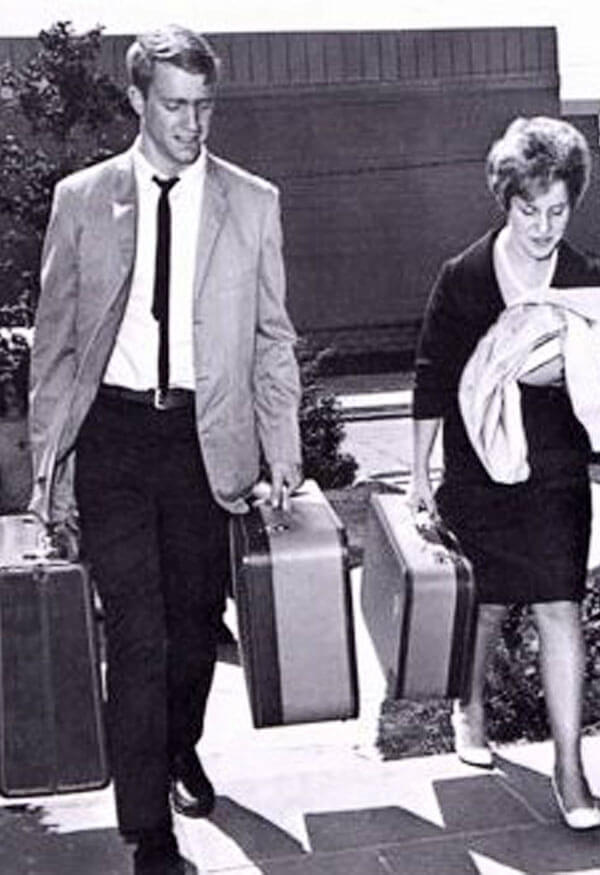
Volunteers Bill deYoung and Mary Dolan carry luggage into Adams Hall, where they spent six weeks in Peace Corps training.
Ladd Thomas was the first coordinator of the Center for Southeast Asian Studies.
Date posted: May 17, 2020 | Author: | Comments Off on Center for Southeast Asian Studies established (1963)

Categories:

As the tidal wave of Baby Boomers hit campus in the 1960s, NIU head football coach Howard Fletcher started a streak of nine consecutive winning seasons highlighted by conference championships in 1963, 1964, and 1965, Mineral Water Bowl appearances in 1962, 1963, and 1965, and, of course, the spectacular 10-0-0 season that earned  College Division National Championship designations from both the Associated Press and National Association of Intercollegiate Athletics polls in 1963. Fletcher’s success  eventually provided the impetus for elevation to NCAA University Division status in all sports.

In this era, Fletcher and his Little All-America quarterback George Bork first became local household words, then national media darlings synonymous with the forward pass. Bork and NIU repeated as both individual and team statistical national passing yardage kingpins, and Bork became the first collegiate passer to throw for 3,000 yards (3,077, to be exact) in a single season at any level of American football.

During that magical 1963 season, Bork was featured in Sports Illustrated, Time, The Christian Science Monitor, the New York Daily News, plus in Chicago’s American by a young sportswriter named Brent Musberger.

At the time, the 1963 Huskies were the most talented group in NIU history. Alumni and fans wanted NIU to capitalize on that success, and that meant upgrading facilities. Sports media of the era called the campaign for a new stadium “the house that Bork built.”

Rustic, cozy, 5,500-seat Glidden Field, NIU’s gridiron home since the school’s origins and located east of Gilbert Hall where the art and music buildings are now, struggled to accommodate some of the five-digit attendance figures in Fletcher’s sideline heyday. It was outdated and not to NCAA University Division or Mid-American Conference standards.

NIU athletics director George “Chick” Evans started lobbying for a west campus facility that would house not only student-athletes but future physical education teachers (rationalization for the three teaching gyms originally underneath the West Grandstand). Behind the scenes, the planning had started, and on January 30, 1964, a groundbreaking ceremony took place.

Designed by architects Holabird and Root of Chicago, the stadium was built by Peterson-Roberts Construction of Rock Island, Ill, at a cost of $2,265,172 in 1965 bond revenue dollars. The natural grass surface lasted four seasons before AstroTurf was installed in 1969, 1980, 1990, and then FieldTurf in 2001 and 2009. The East Grandstand was added in 1995 at a cost of $4,000,000. Significant 21st century additions include the Yordon (2007) and Chessick (2013) centers. The seating capacity of Huskie Stadium has varied from the original 20,257 figure to 31,000 in 1995 with the end zone bleachers to the current 23,595.

Due to construction delays, NIU played the first three home games of its 1965 schedule at Glidden Field. Finally, on November 6, 1965, the 20,257-seat west campus superstructure was dedicated on Homecoming / “Legislator’s Day” with a 48-6 triumph over Illinois State behind one of Bork’s successors at QB, Ron Christian, before 18,856 spectators that included an impressive VIP guest list of state and local politicians.

As part of the university’s 75th anniversary observance in May, 1974, it was officially named “Huskie Stadium” by NIU President Richard Nelson and a local blue ribbon committee. In subsequent years, players and coaches affectionately nicknamed their home “The Doghouse.”

(By Mike Korcek, former Sports Information Director, retired.)

Click on photos to enlarge

The stadium’s predecessor was dear old Glidden Field, capacity 5,500, located on the east end of campus in the area where the Music and Art buildings now stand.
The exciting play of quarterback George Bork and the teams of the early 1960s drew far more fans than Glidden Field could accomodate. Sportswriters called Huskie Stadium “the house that Bork built.”
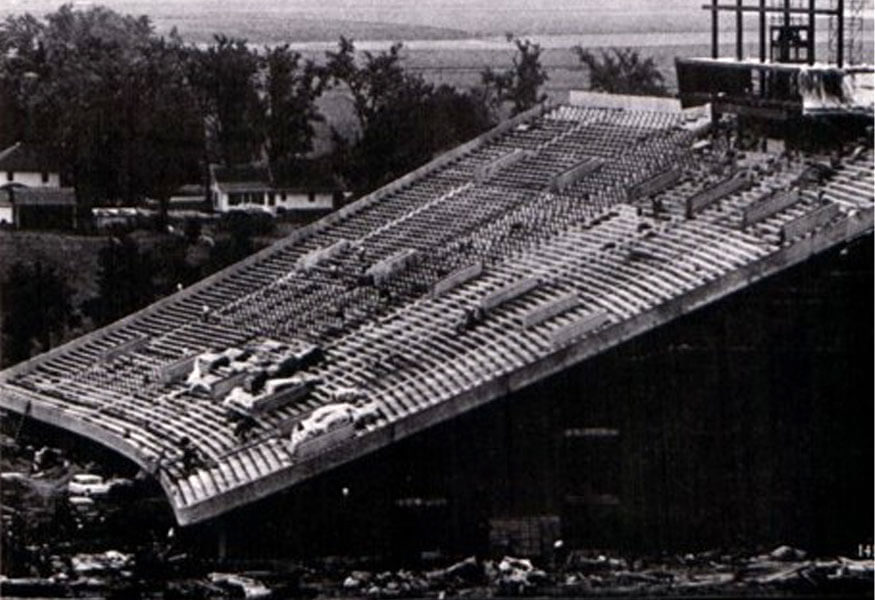
The stadium under construction in 1964; it cost just over $2.2 million.
Huskie Stadium in its original incarnation with a seating capacity of 20,257 and natural grass turf.
The facility wasn’t actually named Huskie Stadium until 1974.
An enthusiastic crowd was on hand Nov. 6, 1965 as Huskie Stadium was dedicated on Homecoming / Legislators’ Day and the Huskies defeated Illinois State 48-6.
Date posted: May 17, 2020 | Author: | Comments Off on Huskie Stadium opens (1965)

Categories:

Among the many milestones in NIU’s evolution from teachers college to research university was the establishment in 1965 of the University Press. A growing portfolio of doctoral programs brought a new cohort of faculty with established research interests and published studies. President Holmes took great pride in showing visitors an entire shelf of books in his office written by NIU faculty.

Holmes recognized that published research brought a new level of prestige to the university, and established a committee to investigate the feasibility of establishing a university press at NIU. Chaired by E. Nelson James, the group visited several other nearby university presses and prepared a report that recommended establishment of a press at Northern.

A University Press Board was convened for the first time in May of 1965. The group considered three manuscripts from NIU professors and settled on Heartland: Poets of the Midwest, edited by Lucien Stryk of the Department of English as its first publication. They also hired Jack Barker, formerly director of the Northwestern University Press, to be the first director of the NIU Press.

Over the years, the Northern Illinois University Press has worked to support and enhance the reputation and research mission of the university by publishing outstanding works of scholarship for a global audience. The Press has long published major works in Russian, Slavic and Eurasian studies; European, Southeast Asian and American history; religion and philosophy. The NIU Press also publishes books on politics and American Midwest history and culture, and today has more than 600 books in print.

In July of 2019, the NIU Press became an imprint of Cornell University Press. NIU employs an acquisitions editor and a faculty press board to choose new publications, while Cornell handles editing, production, marketing and sales. Publishers Weekly called the arrangement “a model for the future of academic publishing.”

Click on photos to enlarge

Lucien Stryk, the first faculty member to have a book published by the University Press.
The first book published by the University Press, a collection of poetry by Midwestern writers, edited by Lucien Stryk of NIU’s Department of English.
Mary Lincoln, the longest-serving university press director in the country at the time of her 2007 retirement, led the NIU Press for 27 years.
Date posted: May 17, 2020 | Author: | Comments Off on University Press established (1965)

Categories:

Off-campus or extension programs at NIU date back to the presidency of Karl Adams in 1939 when the first university classes were offered in the evening at area high schools.

These early programs were exclusively offered to in-service teachers seeking advanced degrees and/or certifications.

By 1957, this collection of programs in a variety of locations became formalized under the name “Evening College, and became part of the university’s collegiate structure in 1961. Five years later, off-campus courses were further formalized through a reorganization that created the College of Continuing Education.

Initially, most degrees and course offerings were for teachers, but as the institution evolved from teachers college to university, the scope of external programming also reflected that growth. Most off-campus academic programming was at the graduate level, but undergraduate work in nursing and the Bachelor of General Studies degree also found a large off-campus audience.

One of NIU’s most interesting extension programs began in the 1960s and continued on for more than two decades: the education of Illinois prison inmates. NIU sent faculty into prisons at Stateville, Sheridan, Dwight and Pontiac, and many professors reported that that some of their best students were inmates. The program ended in 1988 when the state began requiring drug testing for all who entered the prisons, and NIU refused to subject its faculty to such scrutiny.

The first dean of CCE was Virgil Alexander, followed by Clive Veri in 1972. Veri was a creative and aggressive proponent of off-campus programs who vehemently argued that “a student was a student,” and that the university should modernize its thinking about extension offerings. Among his accomplishments was the adoption of the “student at large” designation that allowed students who were not yet committed to an academic major to enroll in credit courses.

The Veri decade was characterized by increasing campus recognition of the importance of the so-called “adult student,” by the development of graduate programs in adult education, and by the establishment of college-specific external program offices staffed by employees with related academic disciplines. 

Click on photos to enlarge
NIU off-campus or extension programs date back to the late 1930s.
For more than 20 years, NIU offered credit courses at Illinois prisons. Here a faculty member teaches a German class at Joliet State Penitentiary.
Date posted: May 17, 2020 | Author: | Comments Off on College of Continuing Education established (1966)

Categories:

As NIU continued its evolution from teachers college to research university in the 1960s, some feared that teaching would be relegated to a lesser status among faculty accomplishments.

To counter those fears, a committee led by Executive Vice President Francis “Bud” Geigle initiated a program in 1966 to promote and reward outstanding teaching and to provide “encouragement and incentive for teaching achievement.” NIU’s Excellence in Teaching Awards (later renamed Excellence in Undergraduate Teaching Awards) are the longest-running such award in Illinois, and the only one in which students play a primary role by nominating candidates and helping make the annual selections.

The first EUTA recipients were Donald Kieso, Richard Little and Donald Murray. In its 54-year history, the EUTAs have gone to 152 excellent teachers. Full list of EUTA recepients

In 2006, NIU added instructors to the list of those eligible for teaching awards with the Excellence in Undergraduate Instruction Awards. Seventeen outstanding instructors have been honored with the EUIA since its inception. Full list of EUIA recipients

Click on photos to enlarge

The second class of EUTA recipients from 1967 are (from left to right) John H. Collins, History; John E. Bower, Chemistry; and Lucien H. Stryk, English.
Date posted: May 17, 2020 | Author: | Comments Off on The Excellence in Undergraduate Teaching Award is established (1966)

Categories:

In 1965, the changing nature of Illinois public higher education brought about a name change for its governing board: The Teachers College Board became the Board of Governors of State Colleges and Universities.

Yet NIU and other state universities could not help but notice the substantial advantages afforded to those universities with independent governing boards: the University of Illinois system and the Southern Illinois University system. In the earlier campaign that brought Northern its full university status and name, State Senator Dennis Collins and others had lobbied for independent governance for NIU.

While independent governance was not achieved for many more years, state higher education officials finally acknowledged that one large board for 10 very different universities was not optimal. Thus was created the “System of Systems,” in which NIU and ISU (and later Sangamon State/U of I – Springfield) were lumped together under a new governance structure called the Board of Regents. Beginning in 1967 and continuing on for nearly thirty years, higher education in Illinois operated under a four-system structure: The U of I system, the SIU system, the Board of Regents system, and the State Colleges and Universities System (later known as the Board of Governors system).

Date posted: May 17, 2020 | Author: | Comments Off on NIU placed under the Board of Regents (1967)

Categories:

Year Name NIU Department
2019 Kate Cady Communication
Myoung Jung Special & Early Education
Tim Ryan History
2018 Emma Kuby History
Jie Chen School of Nursing
Amanda Littauer Center for the Study of Women, Gender and Sexuality
2017 Paul Dawkins Mathematical Sciences
Diane Rodgers Sociology
Katja Wiemer Psychology
2016 Jason Hanna Philosophy
Jeanne Isabel Allied Heath & Communicative Disorders
Qingkai Kong Mathematical Sciences
2015 Steven Daskal Jason Hanna
Amanda Durik Psychology
James Horn Chemistry & Biochemistry
2014 Mary Lynn Henningsen Communication
Geoffrey Pynn Philosophy
Toni VanLaarhoven Special and Early Education
2013 Timothy Aurand Management
Rebecca Hannagan Political Science
Betty Helen LaFrance Communication
2012 Terry Bishop Management
Nancy LaCursia Nursing & Health Studies
Andrea Radasanu Political Science
2011 Michael Konen Geography
Michael Morris Foreign Languages & Literatures
Brendan Swedlow Political Science
2010 J.D. Bowers History
Dennis Cessarotti Technology
Kenneth Gasser Biological Sciences
2009 Mylan Engel Philosophy
Lesley Rigg Geography
Jeanette Rossetti Nursing
2008 Anne Britt Psychology
Ed Klonoski Music
Melissa Lenczewski Geology and Environmental Geosciences
2007 Judith Lukaszuk Family, Consumer and Nutrition Sciences
Carla Montgomery Geology and Environmental Geosciences
Julie Robertson Nursing
2006 Katharina Barbe German
Lisa Finkelstein Psychology
David Gunkel Communication
2005 Julie Hillery Family and Consumer and Nutrition Sciences
Lee Shumow Leadership, Educational Psychology & Foundations
Allan Zollman Mathematical Sciences
2004 Kristen Myers Sociology
Amy Newman English
Lawrence Stoffel Music
2003 Jenny Parker Kinesiology and Physical Education
Joseph Scudder Communication
David Sinason Accountancy
2002 Richard Blecksmith Mathematical Sciences
James Giles English
Christopher Jones Political Science
2001 Rick Ridnour Marketing
William Koehler Music
Judith Testa Art
2000 Donald E. Hardy English
Ayhan Lash Nursing
Ronnie Wooten Music
1999 Daniel Grubb Mathematical Science
Chhiu-Tsu Lin Chemistry and Biochemistry
Kathleen Propp Communication Studies
1998 David S. Ballantine, Jr. Chemistry
Linda M. Johnson Accountancy
Jay A. Stravers Geology
1997 Dianne Cearlock Allied Health
Angela Powers Communication
Stephen Squires Music
1996 Elizabeth Kay Allied Health
Sean Shesgreen English
Gordon Hilton Political Science
1995 Gary Glenn Political Science
Bernard Harris Mathematical Sciences
Promod Vohra Technology
1994 Arthur Doederlein Communication Studies
Henry Leonard Mathematical Sciences
Seymour Simon Psychology
1993 Curtiss Behrens Management
Harvey Blau Mathematical Sciences
B. Diane Kinder Educ. Psychology, Counseling, & Special Education
1992 Arra M. Garab English
Antonio J. Garcia School of Music
Sondra King Human and Family Resources
1991 David E. Keys Accountancy
Charles Larson Communication Studies
Charles J. Olson School of Art
1990 William Blair Mathematical Science
Robert LaConto Journalism
Helen Merritt School of Art
1989 Jeffrey Chown Communication Studies
Curtis Norton Accountancy
Carl Roskott Music
1988 William Johnson English
Randall Newsom Theatre Arts
Ahmed Rifai BSA
1987 Donald Brod Journalism
Elliott Lessen LDSE
Peter Nicholls Math
1986 John Beachy Math
Darrell E. Newell Electrical Engineering
J. Patrick White History
1985 Arnold Hampel Biological Sciences
Richard H. Howland Marketing
William Snyder Chemistry
1984 Sue Warrick Doederlein English
Kuo-Huang Han Music
John R. Simon Accountancy
1983 Charles A. Pennel English
William M. Shearer Communicative Disorders
Harold O. Wright, Jr. BEAS
1982 Laszlo Hanzely Biological Sciences
Askari H. Kizilbash Marketing
Avra Liakos Art
1981 Jaroslaw Komarynsky Finance
F. Marion Miller Chemistry
Diane Ragains Music
1980 Charles (Tim) Blickhan Music
Walter S. Dewey Theatre Arts
Linda R. Sons Math
1979 Floyd L. Crank BEAS
Gustaaf Van Cromphout English
Robert F. Wheeler Math
1978 Jan Bach Music
James Hendricks Accountancy
Doris Crank BEAS
1977 Lawrence Hapeman LDSE
Jack Villmow Geography
Richard Preston Physics
1976 Esther Mocega-Gonzales Foreign Languages and Literature
Patrick Delaney Accountancy
Louis Mustari Art
1975 Sharon A. Plowman Physical Education
Norman Potts Theatre Arts
John Starkey LDSE
1974 Dimitri Liakos Art
Margaret Wood Speech Communication
Ruth Woolschlager BEAS
1973 Mazhar Hasan Physics
Kathryn Iliff Accountancy
Paul Steg Music
1972 Leonard Kouba Geography
M. Jack Parker Speech Communication
Vernon Wills LEPS
1971 Frank Bazeli LEPS
Allan Dionisopoulos Political Science
Hallie Hamilton Journalism
Ralph Novak Management
Elwood Smith Music
Joe Vaughn Chemistry
1970 Abdul Basti Finance
Mary Frances Reed Home Economics
John Rhoads Sociology
1969 Arnold Fox English
E. Edward Harris BEAS
Edward Herbert English
1968 J. Hubert Dunn Physical Education
Parvine Mahmoud Foreign Languages and Literature
Rosalie Reynolds Chemistry
1967 John Bower Chemistry
John Collins History
Lucien Stryk English
1966 Donald Kieso Accountancy
Richard Little Political Science
Donald Murray English
Date posted: May 17, 2020 | Author: | Comments Off on NIU Excellence in Undergraduate Teaching Award Recipients

Categories: