In the long story of Northern’s growth into a major public university, the development of its Libraries plays a key role.

By the early 1950s, NISTC had successfully lobbied to create a Graduate School – but with the caveat that its library holdings be greatly expanded. The existing Haisch Library on the second floor of Altgeld Hall was clearly not sufficient in the booming post-war era, and plans were made for a new library befitting of NISTC’s new stature.

Set halfway between Adams Hall on the north end and Davis Hall on the south, Swen Franklin Parson Library featured a soaring vaulted entrance, leaded glass windows and a Gothic architectural style that evoked the great academic libraries of Europe.  Perhaps more importantly, it offered space for 150,000 volumes – nearly twice as many as the old facility.

On December 8, 1952, in one of the most memorable events of Northern’s history, hundreds of faculty, staff and students formed a human conveyer to move 83,000 books (estimated weight: 85 tons) into their new home. President Leslie Holmes led the brigade, and members of The Dames Club set up refreshment stands with coffee and donuts for the volunteers.

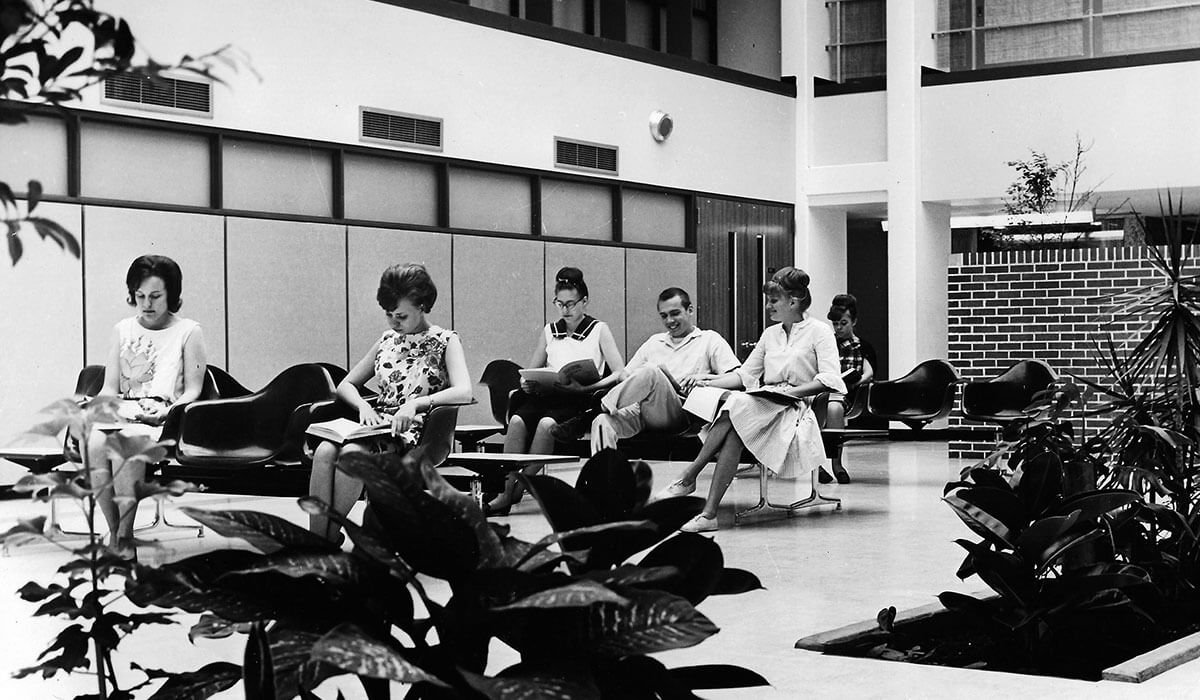
The new library quickly became the center of student life. In addition to the expanded collection and larger facilities, Swen Parson Library housed an art gallery, a music room, a radio broadcast booth and a state-of-the-art lecture hall. 

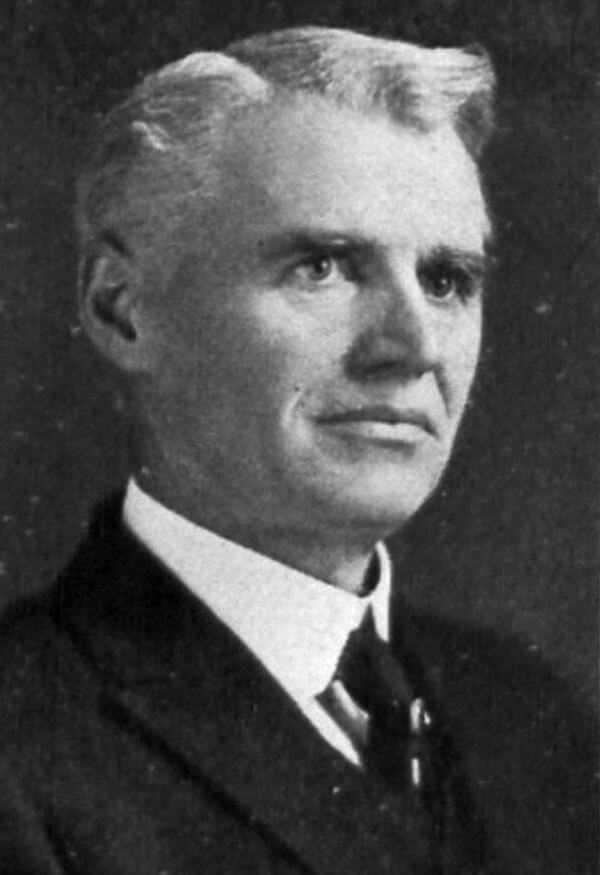
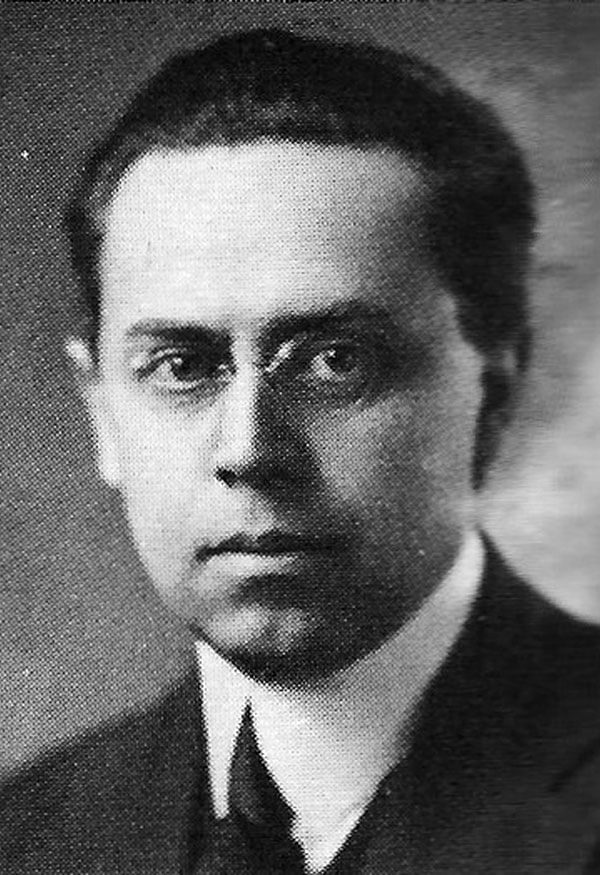
The size and grandiosity of the building that bears his name would likely have amazed Swen Franklin Parson himself. As a 14-year-old immigrant from Sweden, Parson arrived in America with little formal education and no command of the English language. Determined to succeed, he had to start school alongside small children until he could catch up. Eventually he did so, earning a degree at Illinois State Normal and teaching mathematics in the DeKalb public schools. President John Williston Cook hired Parson as one of the original members of his NISNS faculty, and he soon became a much-loved and respected member of the Northern family. So well-thought of was Parson that when President J. Clifton Brown abruptly resigned in 1929, Parson was briefly named acting president.

Swen Parson Hall now houses the NIU College of Law and other administrative offices, but for 25 years it served as the intellectual heart of a university growing in both size and stature.

Click on photos to enlarge

President Holmes led the procession on December 8, 1952 when students and faculty moved 85 tons of books from the second floor Haisch Library in Altgeld Hall to the new library next door.
Hundreds of students formed a human conveyer line to move 83,000 books into the new library.
Swen Parson Library soon became the center of student life.
Swen Franklin Parson
Date posted: April 17, 2020 | Author: | Comments Off on Swen Parson Library Opens (1952)

Categories:

Thousands of listeners throughout northern Illinois and southern Wisconsin get their daily public radio fix compliments of NIU and its NPR stations, WNIJ (89.5-FM) and  classical WNIU (90.5-FM). Operating out of modern studios and including “repeater” stations throughout the region, today’s Northern Public Radio enterprise bears little resemblance to its beginnings in a tiny 10-watt station with a tower tucked behind Jimmie’s Tea House on College Avenue.

NPR’s DeKalb history began in 1954, with a small station operating under the call letters WNIC, and broadcasting just a few hours a day with announcements of campus events, lectures and music. A decade later, in 1964, the station’s broadcasting power was increased to 2,500 watts, covering DeKalb, Sycamore and most of DeKalb County.  Programming evolved as well, focusing more on music and local news.

In 1967, President Lyndon B. Johnson signed a law setting up public broadcasting in the U.S. and establishing the Corporation for Public Broadcasting.  CPB ensures access to non-commercial content, and distributes funding to nearly 1,500 locally owned public radio and television stations.

By 1974, WNIU was given authority to raise its power to 50,000 watts. Classical music and jazz were programming staples, along with NPR’s “All Things Considered”, and reception now extended to Rockford.  Five years later the station’s audience expanded again with the addition of the Northern Illinois Radio Information Service (NIRIS), which provides reading of daily newspapers, magazines, books and other materials for people with visual and print-reading impairments. Reception for all audience members improved dramatically in 1988, when the station’s transmitting tower was moved to suburban Lindenwood.

WNIJ signed on the air in 1991, and programming was split between two distinct services: WNIU adopted an all-classical-music format, while WNIJ provided news, jazz and entertainment. The whole operation received another boost that year when it moved into its current space, the Northern Broadcast Center, at 801 North First Street in DeKalb. At the same time, much of the NIRIS operation moved to Riverfront Museum Park in Rockford.

Northern Public Radio as we know it today came to be in the mid-1990s, when WNIJ and WNIU swapped frequencies. WNIJ became a news-talk station while WNIU continued its classical music direction. Around the same time, NPR received a federal grant to build “repeater stations” in areas previously unserved by public radio: LaSalle, Sterling and Freeport.

Today Northern Public Radio is a major connection between NIU and its region. Locally produced content includes “Sessions from Studio A”, which introduces listeners to local and regional musicians; “Perspectives”, a daily opinion piece voiced by area listeners; podcasts on a variety of topics; and local news coverage. Nationally-produced programs also inform and entertain, including the venerable “All Things Considered”, “Wait, Wait – Don’t Tell Me!”, and “Morning Edition.”

On Classical 90.5, listeners hear programming unavailable anywhere else, including broadcasts from the Metropolitan Opera, Carnegie Hall, and the great symphonies of New York, Chicago and San Francisco. From humble beginnings in a small campus studio to a five-station network reaching more than 100,000 listeners each week throughout northern Illinois and southern Wisconsin, Northern Public Radio continues to inform and entertain in a new century, where generous donors help support the station where they “learn something new, every day.”

Click on photos to enlarge

President Rhoten Smith presented weekly “Chats With Rhoten Smith” on early campus radio.
A student engineer prepares to launch a prerecorded program on a reel-to-reel tape machine.
One of the many locations for campus radio was the old College Tea Room (later known as Kishwaukee Hall).
Student Diane Lacson broadcasts from WNIC studios in the Swen Parson Library auditorium in 1956.
Date posted: April 17, 2020 | Author: | Comments Off on Public radio comes to Northern (1954)

Categories:

When Leslie Holmes became president in 1949, it had been more than a quarter century since Northern’s the last title change. In the early years of his presidency, Holmes maintained the posture of his four predecessors with respect to the school’s mission – namely, that it was focused almost entirely on the preparation of teachers, and thus should maintain “teachers” in its title.

But times were changing, and pressure mounted for Northern to join its sister schools in broadening its curriculum and purpose.  By the early 1950s, Holmes publicly relented, telling alumni in a newsletter article that, after a long period of serious thought, he would be amenable to inaugurating a multi-purpose institution so long as teacher education did not suffer. He had become convinced that this was possible, he said, after many conversations with his colleagues at other schools. The other presidents, he reported, said that their teacher education programs had actually been strengthened, and that the additional programs, especially in the liberal arts, were helpful in enlisting an increased number of teachers.

While faculty reaction was mixed, Holmes had strong community support for moving Northern from teachers college to university. Chief among those proponents were State Senator Dennis Collins and Board Chair Kenneth Snyder, both of DeKalb. Together with members of the DeKalb Chamber of Commerce, a local College Expansion Committee was formed and an extensive public relations campaign begun.

By January of 1955, several bills were introduced to make Northern a full-fledged university with its own board. Throughout a contentious legislative session that spring, the idea emerged that Northern was “moving too fast,” and eventually the bill that passed merely removed the word “teachers” from Northern’s name.

In June 1955, the amended bills passed both houses, were signed into law by Governor Stratton, and Northern Illinois State College was born.

Click on photos to enlarge

Date posted: April 17, 2020 | Author: | Comments Off on NISTC name changed to Northern Illinois State College (1955)

Categories:

State Senator Dennis Collins had been a strong proponent of creating a full-fledged university in DeKalb, and he was not satisfied with the mere removal of the word “teachers” from Northern’s college name. Since the legislature only met every other year in those days, Collins and other supporters had to wait until 1957 to reintroduce bills to change the name to “university.”

This time, Collins used the intervening period to line up support, and when his new bills were filed, they included sixteen fellow senators from Chicago, Rockford, Champaign, Evanston and Downers Grove as co-sponsors. Furthermore, Gov. Stratton had modified his views on the matter, and told Collins that if the bills passed the General Assembly without the separate board provision, he would sign. 

The Teachers College Board once again expressed its disapproval of the change (which by this time was also being sought by Eastern and Western), but the anti-university board contingent did not prevail. In order to ensure passage, Collins and the co-sponsors agreed to language that would prohibit Northern and the other schools from offering any professional courses leading to degrees in law, medicine, dentistry, pharmacy, engineering or agriculture.

This time, the bills sailed through the legislature. President Holmes once again assured his faculty and alumni that Northern would not lose interest in the training of teachers.

(In fact, after passage of the university bill, growth in the number of students entering the teaching profession continued to expand, and Holmes pursued actions that would allow Northern to train college professors as well as elementary and secondary teachers).

On May 23, 1957, Gov. Stratton signed the bill, and Northern Illinois University was born.

Click on photos to enlarge

Illinois State Senator Dennis Collins represented the DeKalb area for 41 years in the General Assembly. He was the primary legislative proponent for changing Northern’s name from college to university, and also sponsored legislation that brought Lorado Taft Field Campus to NIU.
Date posted: April 17, 2020 | Author: | Comments Off on Name changed to Northern Illinois University (1957)

Categories:

When the Teachers College Board approved the first master’s degree in 1951, its members were adamant that it must be a master’s in education. But by the mid-1950s, pro-growth factions at Northern argued that the institution’s future depended upon a more diverse graduate program.

For a school that began as a teacher’s college and was governed by a body called the Teachers College Board, one can imagine the push-back that greeted every move away from the single-purpose institution. Case in point:  While planning the first master’s degree in education, a great argument broke out about whether candidates should have to submit a written thesis. That sounded like research to growth opponents, so a compromise was reached to call it a “qualifying paper.” 

For some years after the first master’s degree was approved, graduate students were mostly part-time, attending on Saturdays, evenings and in summer session, pursuing courses that led to teaching degrees. But in time, faculty in many departments began to urge that arts and science masters degrees be awarded so that students could go on to pursue doctoral programs at other schools.

Faced with a strong need for more doctorate-holding faculty at the state’s growing public universities, the Board finally relented, and it 1958 NIU was approved to offer the Master of Arts and Master of Science degrees. The following year, the Master of Music and the Master of Fine Arts degrees joined the growing portfolio of graduate offerings.

Date posted: April 17, 2020 | Author: | Comments Off on Board authorizes Master of Arts, Master of Science degrees (1958)

Categories:

NIU’s evolution from single-purpose college to multi-purpose university continued at a rapid pace in the late 1950s.  President Holmes had earlier created a university structure with divisions of student personnel services, business services, regional services and instructional/academic services. The academic services area oversaw program clusters in education, humanities and liberal arts and sciences. But by 1959, the growth of students, faculty and academic programs required a more conventional academic organization.

Executive Vice President Francis “Bud” Geigle was the architect of the new collegiate structure. Three new colleges emerged from the reorganization: The College of Education, the College of Liberal Arts and Sciences, and the College of Fine and Applied Arts (later reorganized and renamed Visual and Performing Arts).

CLAS formed new departments of History, Economics, Political Science, Sociology, Anthropology, Journalism, Library Science, Psychology and Philosophy. The College of Education added new departments of Elementary Education, Secondary Education, Student Teaching, Outdoor Teacher Education, and Nursing, as well as new courses in Special Education.  The College of Fine and Applied Arts included departments of Music, Art, Home Economics, Business Education and Industrial Arts. 

Hundreds of new faculty were hired during the 1960s as new and expanded academic programs were implemented, and the university began work in earnest to create centers of excellence within the larger academic program.

Today the College of Liberal Arts and Sciences is the largest of NIU’s seven colleges, with 19 departments spanning the humanities, social sciences and natural sciences. CLAS touches virtually every new student to the university, regardless of major, through the wide array of general education courses housed within its departments.

The twenty-first century College of Education prepares teachers in early childhood, elementary, middle-level, special education and physical education. Its programs also prepare counselors, librarians, principals and superintendents, while graduates harness instructional technology, crunch test data, reshape curriculum and research how human beings learn.

The College of Fine and Applied Arts was eventually reorganized, with Home Economics, Industrial Arts and Business Education moving to new colleges and the emphasis solidifying around branches of the fine arts. Today the College of Visual and Performing Arts is comprised of three schools, each with award-winning educational programs, exciting performances and exhibits, outstanding art studios, theatres, concert halls and accomplished alumni.

Click on photos to enlarge

Executive Vice President Francis “Bud” Geigle designed the first incarnation of NIU’s modern college system.

Date posted: April 17, 2020 | Author: | Comments Off on Colleges of Education, Liberal Arts and Sciences, Fine and Applied Arts are established (1959)

Categories:

As the 1950s gave way to the early 1960s, statewide planning for higher education focused on accommodating a huge increase of students (from 2,000 at NIU in 1950 to 18,000 by the mid-sixties).

Among the methods used to finance new facilities was a massive state bond issue of $195 million presented to voters in a statewide referendum. NIU and its sister institutions lobbied hard for passage: one PR stunt involved a long-distance relay, with student runners starting in Carbondale and ending up in Chicago.  Daily media coverage of the run brought attention to campus needs, as did editorials such as one in the suburban Daily Herald headlined, “You Can’t Argue With the Stork.”

Eventually the referendum passed, and NIU received about $15 million (approximately $130 million in today’s dollars) to cover the construction of ten new buildings, two new wings for the library and various rehab projects. Most of the state-funded facilities were classroom and office buildings, including Watson, Faraday, Graham, Wirtz, Cole, DuSable, Reavis, Zulauf and Lowden halls.

In addition to proceeds from the state bond issue, NIU issued its own self-liquidating bonds to construct residence halls (Lincoln, Douglas, Grant and Stevenson), the Holmes Student Center, the Chick Evans Field House, and Huskie Stadium.

As former President Monat wrote in his history of the university, “The campus community must have viewed this period as a single extended construction project.”

Students from NIU’s Geovisual Mapping Laboratory created an online map showing how the DeKalb campus has evolved into the vibrant community we see today. Read the NIU Today article.

Click on photos to enlarge

Zulauf Hall was one of several NIU classroom buildings funded by the 1960 state bond issue. Originally called Watson East, Zulauf Hall has been home to the College of Liberal Arts and Sciences since its construction in 1966.

Date posted: April 17, 2020 | Author: | Comments Off on Referendum passes to allow state bond issue of $195,000,000 for new academic buildings around state (1960)

Categories:

Fresh from successful campaigns to add master’s degrees to NIU’s portfolio, academic leaders in the late 1950s began a campaign to create a limited doctoral program. Their rationale was that universities needed to create “master teachers” at colleges, universities and community colleges, and that if NIU wanted to recruit and retain “a more scholarly faculty,” it would be necessary to have a doctoral program.

Beginning in 1957, a twelve-member faculty committee, along with the Graduate Council and eleven sub-committees, began the arduous task of studying every aspect of university structure and readiness for doctoral programs.

In November 1961, the Teachers College Board approved NIU’s request to grant the Ph.D. degree in history and English, and the Ed.D. degree in education and business education. Among those who had championed the doctoral program, the victory was called “the most significant step the university has made since its beginning,” and “the true coming of age of NIU.”

In May of 1964, NIU’s first doctoral degree was awarded in business education as Herbert J. Bergstein received his doctoral hood from Graduate School Dean Robert Thistlewait and Vice President Francis Geigle.

Today, students can earn doctorates at NIU in 24 disciplines, ranging from Chemistry and Computer Science to Art & Design Education and Nursing.

Date posted: April 17, 2020 | Author: | Comments Off on First doctoral degrees approved (1961)

Categories:

In the early 1950s, high school administrators began asking for teacher candidates with backgrounds in business education.  Northern responded with a new Business Education department, originally housed in one of the former “Vetville” barracks on the North Forty. A former New Jersey banker named Francis “Bud” Geigle chaired the department, which consisted of three faculty members who taught 11 courses to 43 business education majors.

Soon the department expanded its offerings to include both bachelor’s and master’s degrees in business administration. Having earlier left the barracks for Altgeld Hall, the department found a new home in McMurry Hall in the mid-1950s. By the end of the decade, nearly 500 NIU business degrees had been awarded, and the department had grown in two different directions: business education and business administration.

By the end of the decade, interest in business degrees had grown exponentially, and so did the administrative structure needed to run an enterprise with departments of Business Education, Accountancy, Management and Finance, Marketing, and Business Administration. In 1961, that collection of disciplines was placed under a new umbrella – the NIU College of Business.

The new College had an immediate need for larger and more integrated space, and in 1964 it moved into the newly-constructed Wirtz Hall.  Five years later, the College’s undergraduate program received the prestigious accreditation of the American Association of Collegiate Schools of Business, or AACSB. And by the end of the decade, nearly 5,000 NIU business degrees had been awarded.

Today the NIU College of Business ranks among the best undergraduate business schools in the country. Closing in on its 60th anniversary in 2021, the College is one of few to enjoy a national ranking for 32 consecutive years. More than 60,000 alumni are business leaders throughout the Chicagoland region and around the world. Current Dean Balaji Rajagopalan is the sixth person to lead the College, following in the footsteps of Thistlewaite, James Benson, Richard Brown, David Graf and Denise Schoenbachler.

Click on photos to enlarge

Robert Thistlethwaite was the first dean of the College of Business.
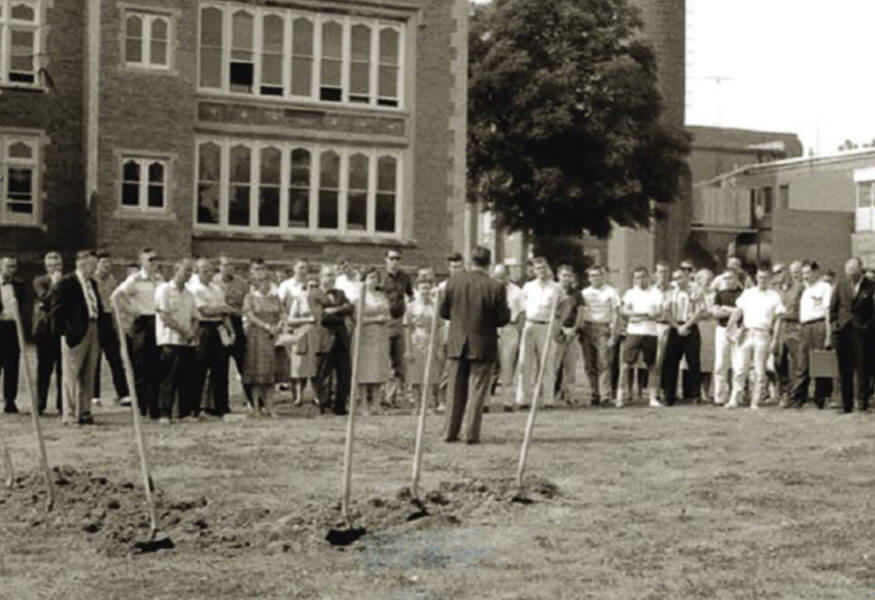
Groundbreaking for Wirtz Hall took place on June 29, 1962.
Students wait for their next classes in the interior court of Wirtz Hall.
Date posted: April 17, 2020 | Author: | Comments Off on The College of Business is established (1961)

Categories:

Music professor (and later dean of men) A. Neil Annas wrote a number of the songs that served the NISNS campus during its earliest years. “Castle on the Hill,” “Alma Mater,” and “Loyalty Song” were sung during Northern’s first half-century.

But tastes – and school names – change. In 1961, the Northern Star issued a call for “a snappier tune” to be sung at athletic events.

Physical education professor and swim team coach Francis Stroup answered the call with a new set of lyrics and a modest rewrite of Neil Annas’ “Loyalty Song.” The Star published the new song on November 17, 1961, and it was an instant hit.

NIU Fight Song

Huskies, come on you Huskies
And make a score or two
Huskies, you’re Northern Huskies
The team to pull us through
Forward, together forward
There’s victory in view
Come on you Huskies, Fight on you Huskies
And win for NIU!

Francis Stroup lived to be 101 – long enough to see his famous lyrics honored as one of the nation’s top 25 college fight songs in a 2000 ESPN national poll.

In 2008, a shaken university community found strength in a single line from Stroup’s lyrics: “Forward, together forward.” The phrase remains a rallying cry during challenges of every type, as members of the university community invoke its power to inspire.

We are in this together, it says, and we will prevail.

Click on photos to enlarge

Francis Stroup, professor of physical education and swim coach, penned the lyrics we know today as the Huskie Fight Song.
Neil Annas wrote a version of the Fight Song tune in an earlier choral piece called the Loyalty Song.
Here Francis Stroup submits his new lyrics for the fight song in 1961.
The Northern Star printed Stroup’s lyrics and asked for feedback — which was immediate and positive.

Date posted: May 17, 2020 | Author: | Comments Off on The Huskie Fight Song is introduced (1961)

Categories: