Early in Northern’s history, leaders seeking permission to offer new, non-teaching-related programs had to promise that they’d keep their aspirations modest, and under no circumstance pursue agriculture, law or engineering. Yet within just a few decades, two of those three prohibitions fell away, overcome by expressions of regional need.
Law was a case of political serendipity (taking over an existing law school from a private school that couldn’t afford it), but engineering required building a case from the ground up, with help from business, industry, and politicians.
From 1908 on, Northern offered courses in what were then called “the manual arts” – woodworking, book-binding and metal work among them. Over time, courses in electricity, auto mechanics and machine metals were added to aid the war effort during the 1940s. By the 1960s, they had added programs in numerical control, electronics and graphic arts, and retitled the combined disciplines as comprising the Department of Industry and Technology (IN&T). In the 1970s, programs in drafting, metal machining, power mechanics and engineering technologies were added.
By the early 1980s, President William Monat and Provost John La Tourette began planning in earnest to approach the Board of Regents (BOR) and the Illinois Board of Higher Education (IBHE) for permission to offer an engineering program. Behind the scenes, the heavy lifting of proposal development fell to La Tourette’s assistant, Anne Kaplan, and Associate Provost Lida Barrett, assisted by IN&T’s new department chair, Thomas B. Leamon, a licensed industrial engineer.
The need for engineering programs in northern Illinois became an issue in the 1982 gubernatorial election, with both Gov. James Thompson and challenger Adlai Stevenson III eventually supporting NIU’s bid. Both candidates had adopted economic development as a major campaign push, particularly that based on science, technology and engineering.
An NCHEMS study commissioned by NIU showed that the university’s service area was a composite of high concentrations of technology-dependent industries in the Rockford area’s durable-goods manufacturing sector, and high concentrations of high-technology industries in the west and northwest Chicago suburbs. Together, the consultant’s report read, they made the case for increasing access to engineering education.
On June 21, 1984, the Board of Regents gave its enthusiastic approval to NIU’s proposal to offer undergraduate and graduate programs in electrical, mechanical and industrial engineering. Not long after that, Bill Monat left NIU to become chancellor of the Regency system, and John La Tourette became acting president.
In December 1984 and January 1985, the IBHE (not without disagreement and lobbying against the plan by the University of Illinois and two private institutions), approved NIU’s request on a 12-1 vote with one abstention. More importantly, they agreed to fund it.
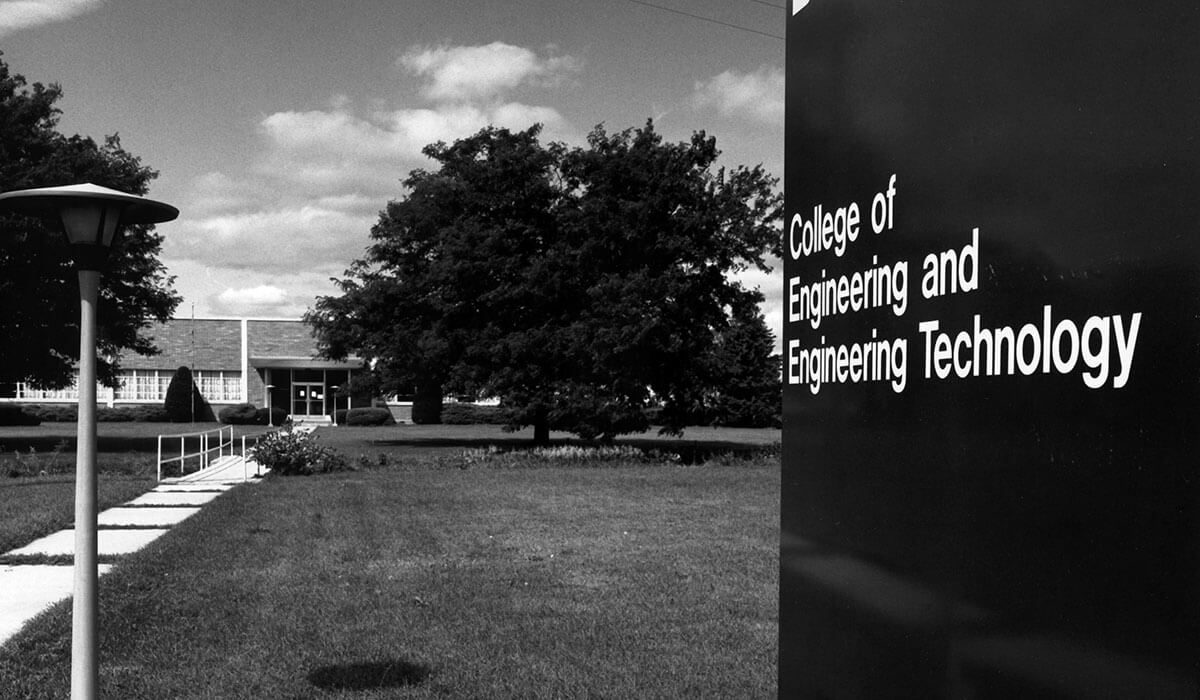
In May of 1985, NIU acquired a major corporate engineering building in Sycamore, about seven miles from campus, as an interim facility. Offering 30,000 square feet on 30 acres of land, the former Anaconda-Ericsson campus was purchased and renovated for $900,000. The facility had just been remodeled, and would have cost $5,000,000 to build new. The NIU College of Engineering and Engineering Technology had a new, if temporary, home. Students began attending classes at the Sycamore site in spring of 1986, and the university provided a shuttle bus to transport students back and forth from the DeKalb campus.
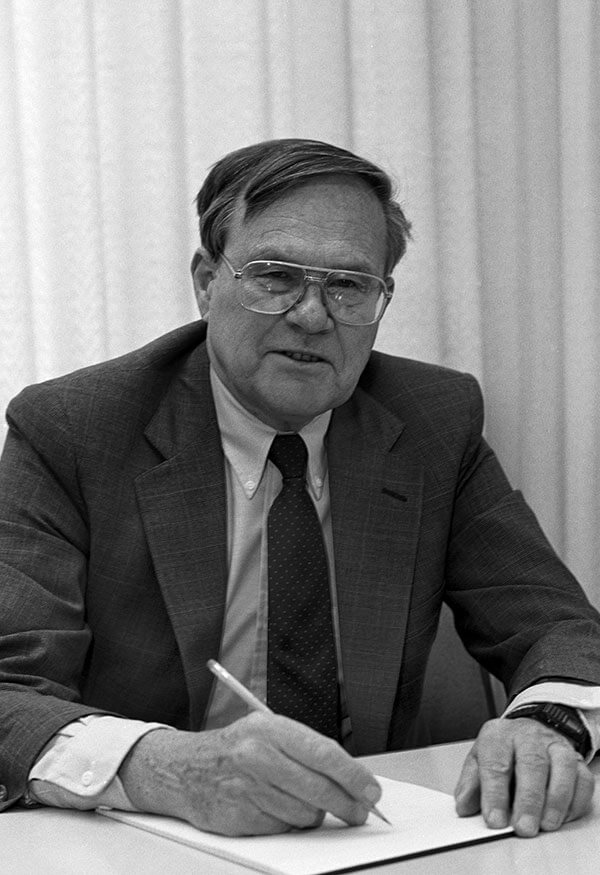
Having played a central role in developing the engineering proposal, Tom Leamon was a logical choice to serve as the college’s acting dean while a national search was underway.
In the meantime, Clyde Wingfield replaced Acting President John La Tourette as NIU’s ninth president. It was Wingfield, then, who on April 24, 1986, announced the appointment of NIU’s first permanent Dean of the College of Engineering and Engineering Technology, Romualdas Kasuba.
Kasuba, a licensed engineer, was then director of graduate studies at Cleveland State University. He would serve as NIU’s engineering dean for 17 years. By the second year of his deanship, the College was serving more than 700 students and had been certified by the Illinois Professional Engineering Act which allowed graduates to sit for licensing exams. And just five years after the program’s inception, NIU Engineering was accredited by the Accreditation Board for Engineering and Engineering Technology (ABET).
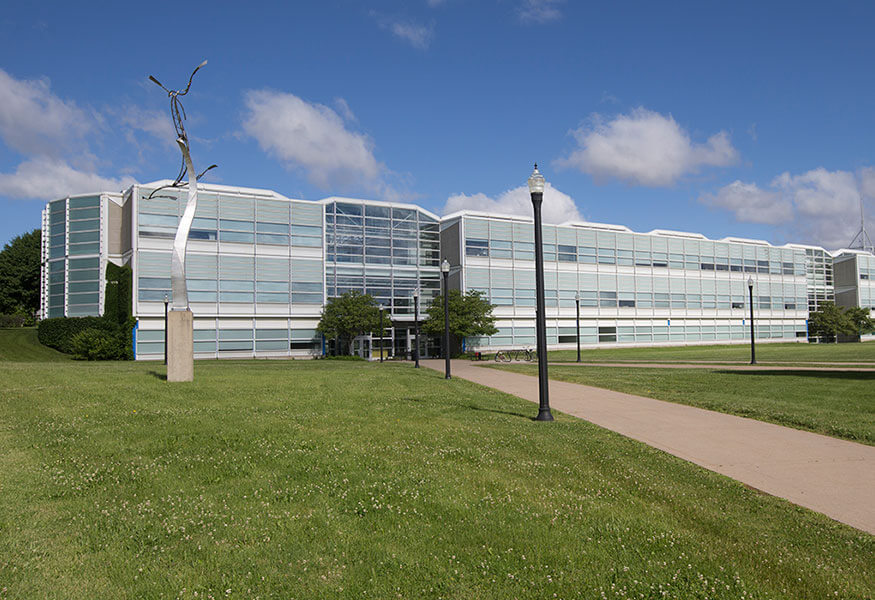
On July 21, 1993, ground was broken for the new Engineering Building, 300 feet north of Anderson Hall on the DeKalb campus. The facility would encompass more than 100,000 square feet and included 10 classrooms, 30 laboratories and a 120-seat auditorium. It opened for classes in the fall of 1995.
Click on photos to enlarge.