Northern’s
Greek letter social fraternities and sororities were introduced primarily to
provide smaller groups with a sense of personal identification within a growing
and increasingly complex campus community.
While
there had been service organizations with Greek names since the 1920s
(e.g., Pleiades for women and the
Cavaliers for men), the predecessors of today’s Greek system would not come
into being for another twenty years.
The first national social sorority on campus was installed on April 29, 1944 as the Alpha Omicron chapter of Delta Sigma Epsilon. Thirty-five pledges comprised this pioneering group.
Three
years later, Phi Sigma Epsilon became Northern’s first national social
fraternity, installed on May 19, 1947.
Beginning in the 1950s, there was a rapid increase in Greek life membership – seven new sororities and fraternities were organized in 1955 alone. In 1959, six more were established.
These Greek organizations soon formed associations of presidents: The Panhellenic Council for women, and the Intrafraternity Council for men.
The
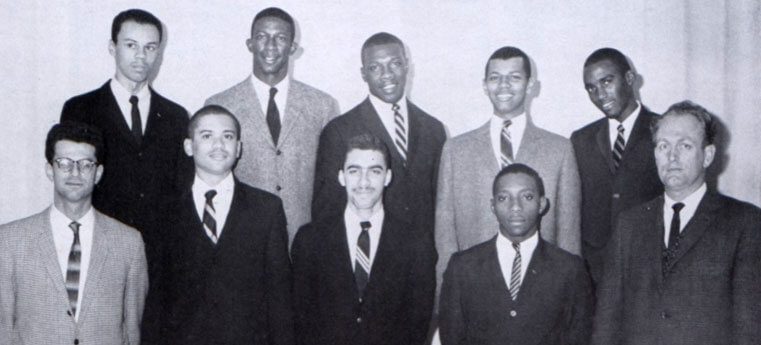
first Black Greek letter organization was organized in 1964 as the Epsilon Phi
chapter of the Alpha Phi Alpha fraternity.
This opened the door for an additional eight organizations under the
control of the National Panhellenic Council, or NPHC.
By
the 1970s, Northern boasted 15 national and local sororities and 22 national
and local fraternities – only a few less than the University of Illinois.
Today, NIU has 44
social fraternities and sororities, with more than 1,600 members.
Click on photos to enlarge
Phi Sigma Epsilon became Northern’s first national social fraternity in 1947.The first Black Greek letter organization was installed in 1964 as the Epsilon Phi chapter of the Alpha Phi Alpha fraternity.Loyal Alpha Phi Alpha members from multiple generations attended a 2019 ceremony that rededicated the Martin Luther King, Jr. bust in the MLK Commons. Few activities are more closely associated with NIU’s Greek system than the annual tug-of-war competition, Tugs. The women’s event takes place each fall, while the men’s competition is in the spring.Tugs has been going on for more than 50 years. Beyond the entertainment value, Tugs raises money for select charities.
Date posted: March 13, 2020 | Author: Brian Walk | Comments Off on First official Greek organizations installed (1944)
Following
the unexpected death of Karl Adams, Northern once again went to Illinois State
University for a new president.
Leslie
Holmes was a native of Freeport, Illinois who loved nature, studied both
geology and geography, and did a stint as a Skelly Oil Company geologist before
entering the teaching profession. At ISU he was a popular professor who
regularly hosted field trips to Canada known as the “Red Bird Field
Courses.”
Holmes
soon came to the attention of the ISU president, who made him one of his top
assistants. It was from this position that Holmes was recruited to the Northern
presidency.
Holmes
was an unlikely candidate to preside over a period of time that could rightly
be called the era of greatest change in Northern’s history. Somewhat shy and
reserved, Holmes nonetheless earned a reputation as an able administrator who
connected well with students. Like his predecessors, Holmes was personally
conservative and religious – characteristics that would be sorely tested during
the fast-changing period of his presidency. He initially shared his forebears’
belief in keeping Northern a single-purpose, teacher training school, but
eventually Holmes recognized that public demand for a broader curriculum could
not be denied.
As
historian Earl Hayter puts it in his history of NIU’s first 75 years, “The key
to the development of Northern from a small teachers college to a sprawling
university during the 1950s and 1960s is found in the population explosion in
the 21 northern counties of Illinois.”
From 1940 to 1950, 86 percent of the state’s considerable population growth
was in the northern Illinois region.
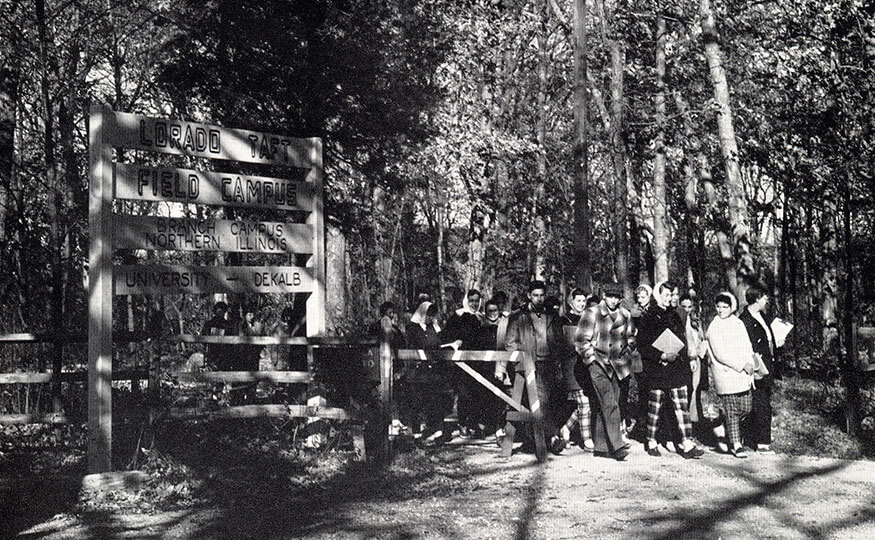
During Holmes’ 18-year presidency (1949 – 1967), Northern enrollment grew from 2,000 to 18,000 students, and 29 new buildings were added. The introduction of advanced degrees at the masters and doctoral levels promoted Northern to university status during Holmes tenure. And among the accomplishments that gave scientist and outdoorsman Leslie Holmes the greatest satisfaction was the acquisition in 1951 of the 66-acre Lorado Taft Field Campus for outdoor education.
Holmes
retired from NIU in 1967. While he intended to split his time between DeKalb
and his summer home in Wisconsin, he ultimately accepted an offer to teach
geography as a visiting professor at Arizona State University. Holmes died in
Tempe, Arizona in August 1974, just three months after the governing board
voted to name the Student Center after him.
Click on photos to enlarge
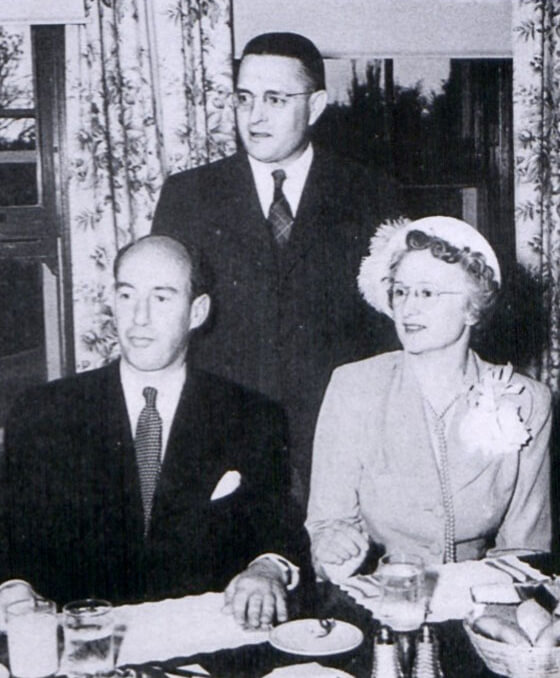
Leslie Holmes walks to his inauguration alongside Gov. Adlai StevensonPresident and Mrs. Holmes pose with Gov. Stevenson at a post-inauguration dinner.President Holmes received a husky-malamute mix from a donor to serve as the first live game mascot.Holmes and legendary Athletic Director George “Chick” Evans oversee construction of what would become the Chick Evans Fieldhouse.Holmes (shown here with his secretary, Clara Sperling) editorialized in support of state funding for campus expansion. The Student Center as it appeared during Holmes’ presidency, absent the 14-story tower. Holmes lived long enough to see the building named for him.
Date posted: March 13, 2020 | Author: Brian Walk | Comments Off on Leslie A. Holmes becomes fifth president (1949)
The impact of philanthropy at NIU may have begun with a shoebox.
Prior to World War Two, President Leslie Holmes kept a small amount of money in his office to help students and faculty with emergency loans. The source of the cash was interest on bequests from graduates over the years, and it had been accumulating since 1900. In 1916, the estate of alumnus Andrew Brown donated the university’s first major gift, and the principal grew to more than $30,000.
Following the war, Holmes knew that another major gift would cause the box to overflow with earned interest – and indeed it did upon receipt of $5,000 from alumni and friends in the name of the late President Karl Adams. Other universities were establishing foundations to manage private giving, and Holmes became convinced that Northern needed to follow suit.
On
March 31, 1949, he and two other administrators signed articles of
incorporation for the Northern Illinois State Teachers College Foundation.
A little more than a decade later, the Foundation began its evolution from a recipient of gifts to a more strategic partnership with the university. The State had issued bonds to help universities across Illinois build new facilities for a rapidly-growing cohort of college-bound students. Unfortunately, that funding model did not provide money to furnish the buildings, and the university could not borrow cash to do so – but the private Foundation could. By buying the furnishings and leasing them to the university, crisis was averted – and the legislature approved repayment of that loan the following year.
Another
major contribution of the early Foundation was the purchase of land surrounding
the university. Many parcels along Normal Road, Lincoln Highway, Annie Glidden
Road, Lucinda Avenue and the west campus were acquired through the Foundation,
taking time-critical advantage of favorable pricing while waiting for state
appropriations via a legislature that only met every other year.
While the early Foundation was able to assist the university with many strategic moves, its primary focus, then as now, was helping students pay for school. Early recipients of such financial assistance were required to sign a pledge saying that they did not drink or smoke and were “generally people of good character.” Such requirements were removed in the late 1960s, but the emphasis on student support endures.
NIU Foundation fundraising activity reached nearly $22 million in FY19, including a multi-million-dollar pledge for scholarships.
The Northern Alumnus newsletter introduces the Foundation and describes two pet projects: purchase of a new piano for the music department, and installation of a proper flagpole near Altgeld Hall.Business manager Emil Anderson suggests potential members for the Foundation Board.
Click on photos to enlarge
Date posted: March 13, 2020 | Author: Brian Walk | Comments Off on The NISTC Foundation is incorporated (1949)
The
beginnings of a graduate program, like other moves away from the
single-purpose-teacher-preparation mission, was slow to take off at NISTC. Some
discussion on the topic began in the Adams administration, but failed to
generate action. World War II further delayed the initiative. Finally, in 1949,
President Leslie Holmes appointed a steering committee to “set up the mechanics
of getting a graduate program started.”
The
State Teachers College Board, under which NISTC was still governed, had the
following requirements: First, Northern needed a bigger library collection in
each field in which graduate work was to be offered. Second, at least half of
all faculty had to have doctoral degrees. Third, all courses had to be taught
on campus; and fourth, the first graduate degree was to be a masters in
education.
Having
been assured that all those requirements had been or soon would be met, the
board finally approved the M.S.Ed on January 22, 1951, and graduate courses
were offered the next term by the departments of biological sciences,
education, English, mathematics, physical sciences, social sciences, and
speech.
The
following year, 28 Masters of Science in Education degrees and certificates of
advanced study were awarded. Today, NIU students can earn masters degrees in 73
different disciplines, and more than 4,000 students are enrolled in graduate
programs.
The first master’s degrees recipients appear in the 1953 Norther yearbook.
Click on photos to enlarge
Date posted: March 13, 2020 | Author: Brian Walk | Comments Off on The first master’s degree is authorized (Jan. 22, 1951)
At
the end of WWII, veterans flooded college campuses like NISTC. In 1946,
enrollment jumped to 901 men and 541 women, more than half of whom had served
in the war. With no dedicated campus living space for men, veterans and faculty
joined forces to find space for male students to live in DeKalb. Beyond that, the
college established a number of makeshift quarters, including cots and bunk
beds in the Still Hall gymnasium, the top floor of the Science Building, and in
surplus barracks borrowed from an Army base in Wisconsin.
President
Adams made the construction of additional dormitories a top priority in his
post-War plans, but legislative support was slow in coming. A new women’s dorm
(later named Adams Hall) was opened in 1949, but it took three more years to
receive funding and construct the first such facility for men.
In
1951, Gilbert Hall was opened as an all-male dormitory with capacity for 374
men. Named for DeKalb’s first superintendent of schools, Newell D. Gilbert, the
new dorm had the advantage of overlooking Glidden Field, the school’s original
football field on the land now occupied by the Music and Art buildings.
Gilbert remained a
popular living space for several decades, particularly preferred by students
with classes on the east side of campus. While it was decommissioned as a
residence hall in the 1990s and used as administrative “swing space” during the
remodeling of Altgeld Hall, Gilbert was eventually renovated and reopened as a
co-ed dorm in 2013.
Click on photos to enlarge
Gilbert Hall decorated for football game, 1950sGilbert’s location had a number of advantages for its residents, including the ability to watch football games on Glidden Field from their rooms. Photographers often perched on the roof.
Date posted: March 13, 2020 | Author: Brian Walk | Comments Off on Gilbert Hall, first men’s dormitory, opens in 1951
During the summer of 1898, noted American sculptor Lorado
Taft and a small group of artists, architects and scholars established a summer
retreat on the estate of a wealthy Chicago arts patron as a place to work,
exchange ideas and social in peaceful isolation away from the city.
Located on a scenic bluff overlooking the Rock River, this
enclave became known as the Eagle’s Nest Art Colony, and it flourished until
the death of its last original member in 1942.
Almost immediately upon his arrival at Northern, President
Leslie Holmes began lobbying the legislature to acquire the property. Holmes
was an avid outdoorsman himself, and he believed strongly in the value of
outdoor education.
In 1951, Northern acquired a portion of the estate
including heavily wooded areas, open fields, ravines and the site of the original
art colony to establish the Lorado Taft Field Campus. Initially it offered Northern
students exposure to outdoor teaching methods; later, the College of Education
developed a Master’s degree in Outdoor Teacher Education. Over time public
schools in the region were given the opportunity to bring children to Lorado
Taft, and the campus evolved into the outdoor education and conference center
it is today.
The Taft campus has expanded from the original 66 acres to
141 acres with team courses, campfire rings and other outdoor gathering areas,
sports fields and hiking trails through wooded and open areas and over a
variety of terrain. The 15 buildings include a science lab, dining hall,
dormitories, classrooms, meeting and conference rooms, staff residences and
offices, and a maintenance shop.
Three buildings date back to the early days of the art colony and are more than 100 years old. Several sculptures by Lorado Taft remain on the grounds, and Taft’s 60-foot tall sculpture of the Eternal Indian (popularly if incorrectly known as Blackhawk) overlooks the Rock River a few hundred feet from the campus in adjacent Lowden State Park. Today, the Taft campus provides resident outdoor education programs to more than 6,000 elementary and middle-school students each year, as well as dozens of outside groups seeking a pastoral setting for conferences, workshops and retreats.
Outdoor education was a popular course of study in the 1950s and 1960s.Middle school students examine “The Seven Muses,” a creation of Lorado Taft’s students.An early brochure about the field campus, its history and projected future.
Date posted: March 13, 2020 | Author: Brian Walk | Comments Off on Lorado Taft Field Campus is established (1951)
The
move toward a full-fledged graduate program at Northern was slow, but once it
took off, it met with great enthusiasm from faculty and prospective graduate
students.
In
November of 1949, President Leslie Holmes appointed a steering committee to
work with colleagues at other Illinois public institutions to ensure
coordination of expanded graduate offerings. At the same time, the Teachers
College Board established guidelines for Northern in the areas of faculty
qualifications, library holdings, location of classes and degrees that could be
offered.
In
1951, the Board gave Northern permission to offer graduate courses. The
following year, Dr. J. Robert Hainds was appointed as the first Dean of the
Graduate School. By 1960, 23 departments were offering graduate courses leading
to the master’s degree.
From
1960 to 1970, graduate student enrollment increased from 1,300 to more than
5,000.
Click on photos to enlarge
The first Graduate School catalog, 1951 – 1952Robert Hainds, the first Dean of the Graduate School (and later academic vice president).
Date posted: March 13, 2020 | Author: Brian Walk | Comments Off on Founding of the Graduate School (1952)
“We are living in a world of beauty, but few of us open our eyes to see it.” ~ Lorado Taft
An often overlooked
portion of Lowden State Park in Oregon, Illinois, is the Lorado Taft Field
Campus of Northern Illinois University. To understand this field campus of the
university one must first come to learn its origin as the home of the Eagle’s
Nest Art Colony.
In 1843 the famous writer
and feminist Margaret Fuller came to Ogle County, Illinois, to visit her uncle,
William W. Fuller, an Oregon attorney. Fuller was the first full-time female
book reviewer and newspaper editor in journalism. As a writer she wrote of the
Ogle County area in her book, “At Home and Abroad”, but she did much more. She
was the first to name the area of the “Eagle’s Nest” because of a 500 year old tall,
dead cedar tree where American Bald Eagles were nesting. Also in this location,
on July 4, 1843, she composed one of her best-known poems, “Ganymede to His
Eagle”, for it was Fuller who also named a natural flowing spring “Ganymede’s
Spring.”Ganymede is a divine hero in Greek Mythology. That spring runs into the
Rock River one-quarter mile north of where the Black Hawk statue now stands.
As a consequence of her
visit, when landowner Chicago attorney Wallace Heckman completed his summer residence
in 1893, he named it “Ganymede Farm.” Five years later, from that first summer
of 1898, he would set up an art colony from Fuller’s naming of the “Eagle’s
Nest”. That original old dead “Eagle’s Nest” cedar tree came down in 1972 and a
sign marks the spot of the tree’s location and what is left of its remains by
the front door of the Dining Hall.
To honor Margaret Fuller’s visit and contributions to the area, both a Rock River island (south of Lowden Park) and road (west of Lowden Park) are named after her.
After Chicago’s Columbian Exposition, of 1893, a group of artists and others, led by sculptor Lorado Taft, gathered to continue practicing their arts while encouraging each other. Every one of the newly formed group were either members of the Chicago Art Institute or the University of Chicago Art Department. In time, they opted to escape the heat and congestion of Chicago by summering at a farm in Bass Lake, Indiana. However, an outbreak of malaria at Bass Lake drove them from Indiana to Oregon, Illinois. There, Wallace Heckman, who was a friend of the group and patron of the arts, offered the use of part of his Ganymede Farm summer estate for a lease of one dollar per year.
The Eagle’s Nest Art
Colony was founded the summer of 1898. It was agreed that the lease would run as
long as one of the founding members remained there. The colony was started by
eleven men, consisting of artists, architects, writers, and a musician who all became
affiliated with Taft in Chicago. The original members were:
Charles
Browne (1859-1920), landscape painter, teacher at the Art Institute, and Taft’s
brother-in-law
Ralph
E. Clarkson (1861-1942), portrait painter and lecturer at the Art Institute of
Chicago
James
S. Dickerson (1853-1933), newspaper editor and Secretary of the University of
Chicago
Clarence
Dickinson (1873-1969*), organist musician and church music composer
Horace S. Fiske (1859-1940), poet and teacher at University of Chicago
Henry B. Fuller (1857-1929), novelist who wrote “The Cliff Dwellers”, later namesake to the Chicago fine arts organization of the same name
H.
Hamlin Garland (1860-1940), author and Taft’s brother-in-law
Oliver D. Grover (1861-1927), landscape painter
Irving K. Pond (1857-1939), architect and brother to Allen
Allen B. Pond (1858-1929), architect and brother to Irving
Lorado Z. Taft (1860-1936), sculptor
(*
Dickinson lived the longest but left the colony and later passed away in New
York.)
The Eagle’s Nest Art
Colony was a place of tranquility and inspiration for many Midwestern artists
and patrons of the arts who would come to visit them to see what they were
creating. In later years many other famous writers and artists visited the
colony, among them William Vaughn Moody, Ralph Pierson, Bert Leston Taylor,
Harriet Monroe, Lucy Fitch Perkins, George Barr McCutcheon, John T. McCutcheon,
Dr. James H. Breasted, Mrs. Laura McAdoo Triggs, Edgar A. Bancroft, Charles R.
Crane, and I. K. Friedman. Here, too, came Robert Burns Peattie and his
novelist wife, Elia, who brought their two sons, Donald Culross and Roderick,
both of whom were to become nationally-known writers.
Today, what remains of the Eagle’s Nest Art Colony is found at the northwestern corner of Lowden State Park as 66 acres of the 207 acres of the park. Lowden is one of several Illinois state parks in Ogle County, Illinois. The park was named after Illinois Governor Frank Orren Lowden (in office 1917-1921). Lowden State Park is home to the Black Hawk Statue by sculptor Lorado Taft. The 48 foot tall statue overlooks the Rock River from a bluff some 70 feet above the Rock River looking southwest towards the city of Oregon. The 1910 statue’s 536,770 pounds of concrete and steel is said to be the second largest concrete monolithic (one pouring from the top) statue in the world. The statue was just recently restored by a group of private local citizens and the State of Illinois working collaboratively together.
The 11 charter members, some with family, first lived in shanties and tents at the colony until the association’s constitution was written when charter and regular members were allowed to build summer homes. Taft’s original studio was a converted barn east of the Taft house. The small wooden building had a highly sloped roof which allowed large cast statue figures to be built therein. A skylight was added to allow natural light into Taft’s studio. The first reduced scale models of the “Eternal Indian” (Black Hawk) statue were created inside this studio. Taft’s original studio no longer exists, a Craft Shop now stands on its site.
The Poley House (also called “The Camp House”) was built in 1902 and remains today. The Poley House was designed by the renowned Chicago architects, and brothers, Irving and Allen Pond. The building features bricks above the large, 25-by-33-foot fireplace emblazoned with the art colony motto, a quote taken from Edward Lear’s “The Story of the Four Little Children Who Went Round the World” that reads as follows,
“And
here all these interesting animals lived together in the most copious and rural
harmony seldom if anywhere else in the world is such perfect and abject
happiness to be found.”
The Heckman summer residence
of Ganymede Farm was lost at some point due to a fire. It is said to have once
stood somewhere around the southwest corner of Lowden Park near where the RV
wastewater dumping station is now.
Grover Cottage, like the
Heckman house, no longer exists, though its stone fireplace stands in the
location of the original building. It is one of the first things one sees from
the parking lot. Writer Elia Peattie penned her story “The Girl from Grand
Detour” inside Grover Cottage in 1908. Ralph Clarkson’s cottage is also gone. It
is said to have been a small wooden studio, just south of the Grover house near
where the parking lot is now. It was said to have many windows on three of its
four sides. Clarkson painted commissioned paintings of Chicago Mayor Carter
Harrison and University of Chicago President Harry Pratt Judson there.
Lorado Zadoc Taft passed
away October 20, 1936 and was laid to rest at Elmwood Township Cemetery in
Elmwood of Peoria County, Illinois. Many said the colony “lost its spirit” upon
his passing. Many credit him and Wallace Heckman as having created the very
first “hippie commune” of the United States 60 some years before the term
actually came to be. The colony would carry on for 44 years until the death
of last resident member Ralph Clarkson in 1942.
Northern Illinois State
College President Leslie Holmes (1949-1967) lobbied the State to acquire the
land for the college under his leadership. The college had plans to use the
land to improve the teaching program by retreats to the Taft section of the
park for educational workshops and conferences. On August 7, 1951, Governor
Adlai E. Stevenson II signed a bill into law which transferred ownership of the
northwestern corner section of the park of the Eagle’s Nest Art Colony to
Northern Illinois State College, now known as Northern Illinois University
(NIU), just north of the Black Hawk Statue. The Lorado Taft Field Campus was
born!From 1951 to 1954, Northern Illinois State College renovated six of the
original buildings, including the two first structures built, Poley House and
the home of Lorado Taft.
Some art pieces of the Eagle’s Nest Art Colony still exist at the Oregon Public Library, a piece of local art in, and of, itself as it was designed by the Pond brothers of the colony. Construction on the library was let in 1907 to M.D. Smith of Dixon. A second floor art gallery was included in the design at the suggestion of members of the colony. The colony artists used the gallery space for public art exhibits and lectures. Taft persuaded colony members to donate over fifty works to the library as a permanent collection. These paintings and sculptures remain in the library gallery and may be viewed by appointment. The library opened in 1908. The gallery just celebrated its 100th anniversary opening in 1918.
The first classes were
held at the Lorado Taft Field Campus in August of 1952. Today, NIU’s Outdoor
Teacher Education program at the NIU Lorado Taft Field Campus serves over 4,000
grade school students each year. Three dormitories of the campus make Taft a
residential field campus with a primary focus on outdoor education. The
Dickerson and Browne houses are used by teachers at the field campus. The
campus offers activities such as art (of course), team building, birding,
science projects, nature study, Native American heritage/pioneering, survival
training, orienteering, as well as sporting activities of all seasons. The
Oregon Park District offers luncheon tours of the campus reminiscing back to
the days of the art colony several times each year. NIU’s outdoor education and
conference center is open year-round to groups of up to 160 people by
reservation, usually on weekends when students are away.
To this day, many different
kinds of artists call the Rock River Valley home and continue to find
tranquility and inspiration in this beautiful part of Illinois just
as the artists of Eagle’s Nest Art Colony did 100 years ago.
If you want to visit:
Lorado Taft Field Campus
– by appointment (815) 732-2111, or see the website: www.NIU.edu/taft
In September of 1945, Senator J. William Fulbright introduced a bill in Congress that called for the use of proceeds from the sales of surplus war property to fund “the promotion of international goodwill through the exchange of scholars” in the fields of education, culture and science. One year later, President Harry S. Truman signed the Fulbright Act into law.
The first Fulbright scholar from Northern was historian David Wagner who spent the 1952-53 school year teaching and conducting research in Italy. Over the next 60+ years, some 130 Northern faculty have been chosen for this honor in 163 separate placements. In 1983, NIU ranked 17th in the nation in the number of Fulbright awards, ahead of the University of Illinois, Northwestern and the University of Chicago.
Since its inception, the Fulbright program has broadened its funding to include an annual appropriation from Congress, and expanded its initiatives to include various student exchange programs. Some 35 NIU students have received Fulbright scholarships to study abroad.
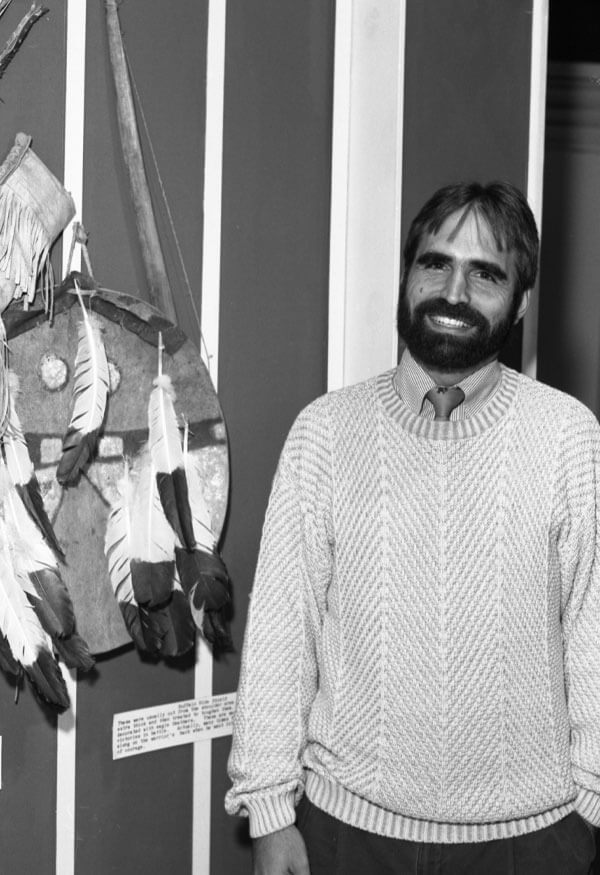
Anthropology Professor Bill Fash received Fulbright awards twice (1987 and 1993) to teach and study in HondurasSusan Russell was the first woman from NIU to receive a Fulbright award. The Anthropology professor traveled twice to the Philippines, in 1978 and 1991.
Date posted: April 17, 2020 | Author: Brian Walk | Comments Off on First faculty member to receive a Fulbright grant (1952)