
Throughout Rhoten Smith’s presidency and well into that of his successor, the Academic Planning Committee and the Council of Academic Deans studied reorganization of the existing colleges. The structure they proposed was approved and went into effect on July 1, 1974, and for the most part continues on to this day.
Key to their plan was creation of a fifth college that would be home to a burgeoning collection of health-related disciplines and, as one administrator described it, “a holding company” for unrelated but similarly “professional” programs.
The College of Professional Studies (renamed the College of Health and Human Sciences in 1995) initially included Nursing (transferred from the College of Education); Library Science (transferred from the College of Liberal Arts and Sciences); and Home Economics and Industry and Technology, both transferred from the former College of Fine and Applied Arts.
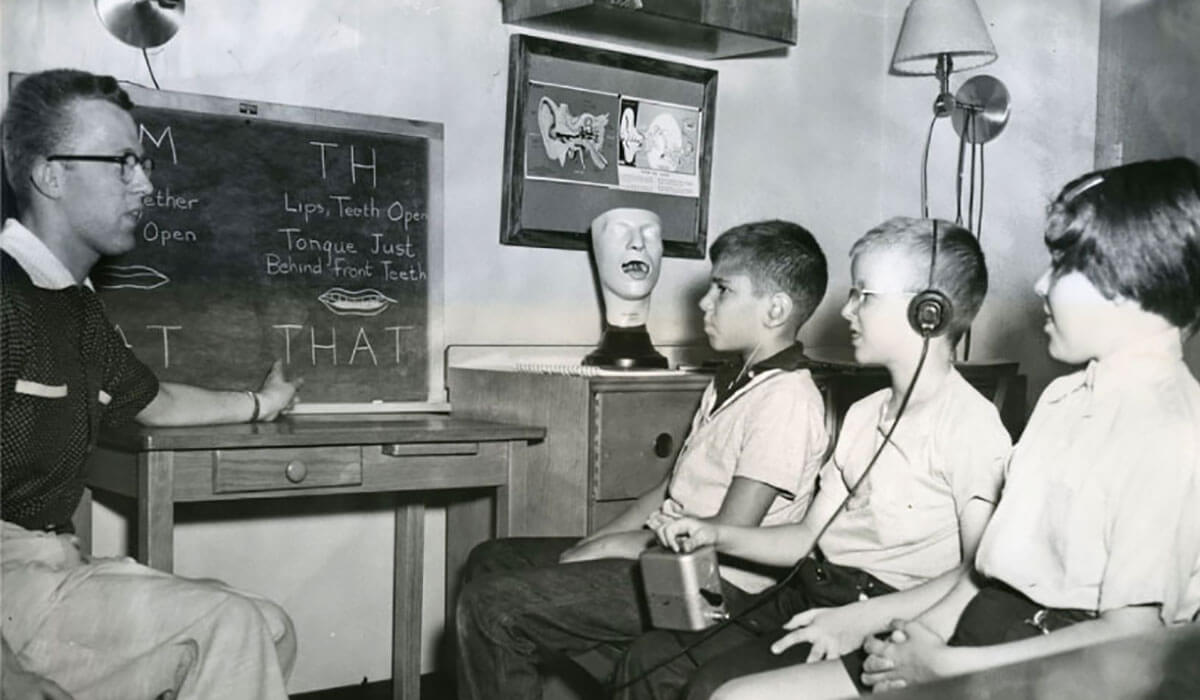
At the same time, they created two new departments for the college from programs previously offered by CLAS: the Department of Communicative Disorders and the School of Allied Health Professions.
To lead this new college, they tapped Dr. Barbara Seelye, a speech pathologist and administrator from St. Louis University. Seelye was the first female dean at NIU, and until the hiring in 1982 of Peggy Barr as vice president of student affairs, the highest ranking female administrator in NIU’s history.
The new college had an enrollment at the time of more than 4,500 undergraduates and 1,000 graduate students, and nearly 100 faculty. The School of Nursing alone enrolled more than 500 undergraduates by the 1970s, making it the largest baccalaureate nursing program in the state.
Over time, the college’s focus narrowed. Industry and Technology was folded into the College of Engineering and Engineering Technology in 1985, while Library and Information Studies was eliminated. A decade later, the college’s name was changed to the College of Health and Human Sciences, with a mission “to advance the education of practitioners in health and human services.”
Today, the College of Health and Human Sciences offers a host of health-related programs, including audiology, gerontology, health education, medical laboratory sciences, nursing, nutrition/dietetics, physical therapy, public health, rehabilitation counseling and speech-language pathology.
Under the Human Sciences banner are programs in early childhood studies, family and child studies, family and consumer sciences, fashion merchandising and hospitality management.
The College is also home to NIU’s Military Science program.
In addition to its 11 accredited programs, CHHS partners with more than 400 external practicum sites that provide excellent opportunities for students to learn, participate in research, and work in the community.